Modern applications rarely work in isolation. When a user places an order, multiple systems need to coordinate: payment processing, inventory management, email notifications, analytics tracking, and shipping integration. Synchronous calls create bottlenecks and cascading failures. One slow service brings down the entire system.
RabbitMQ solves this by decoupling services through asynchronous message passing. It's a message broker that sits between producers and consumers, ensuring reliable message delivery even when services are temporarily unavailable. Used by companies like Uber, Netflix, and Shopify, RabbitMQ handles millions of messages daily.
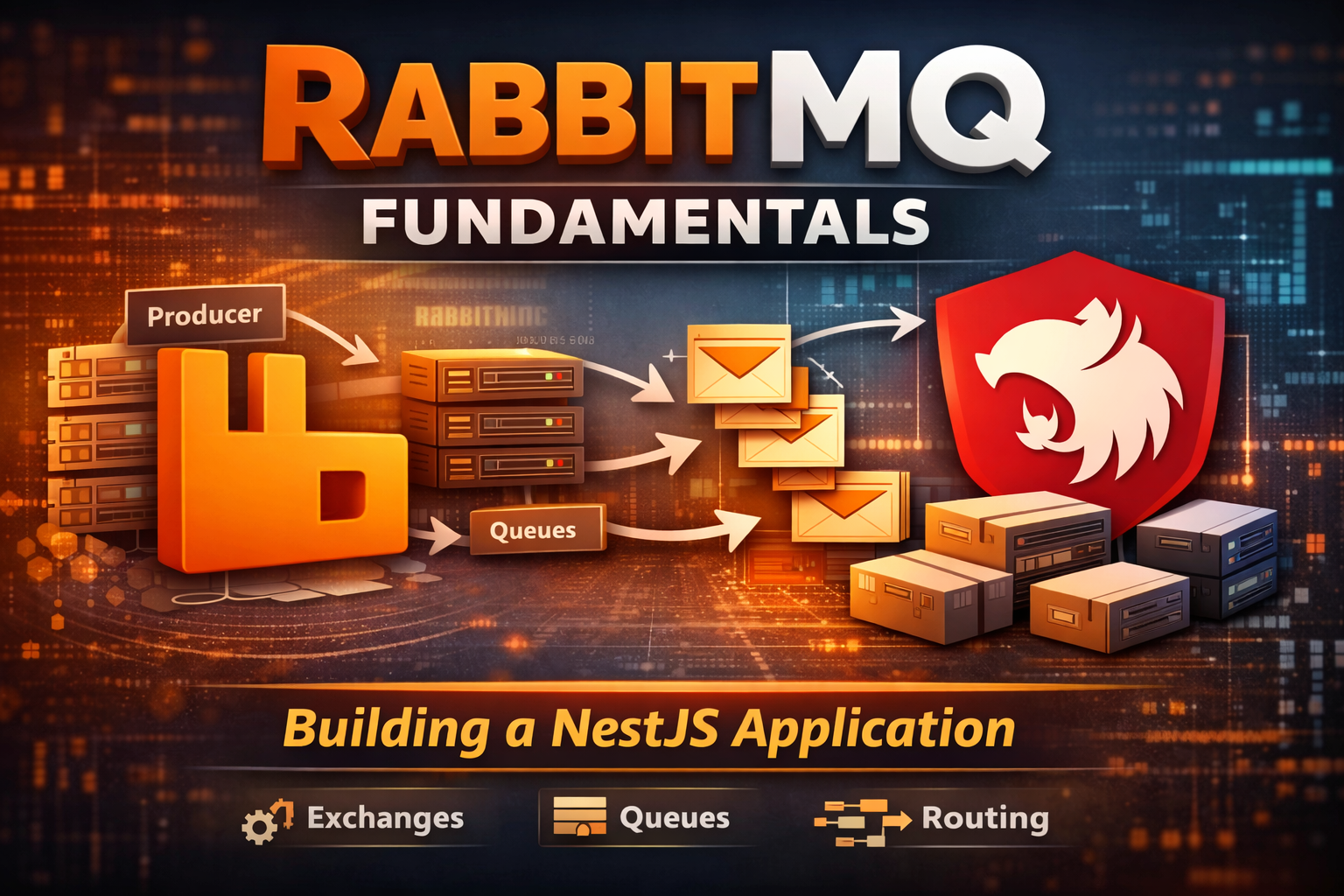
In this article, we'll explore RabbitMQ's architecture, understand every feature from basic queues to advanced routing patterns, and build a realistic order processing system with NestJS that demonstrates production-grade patterns.
Traditional request-response architecture has fundamental limitations:
User → API → Payment Service → Inventory Service → Email Service → Response If any service is slow or down, the entire request fails. This creates:
Tight coupling : Services depend on each other's availabilityCascading failures : One slow service slows everythingPoor scalability : Can't handle traffic spikes independentlyLost messages : If a service crashes mid-request, data is lost
RabbitMQ enables decoupled, resilient systems:
User → API → RabbitMQ → (Payment, Inventory, Email, Analytics all process independently) Benefits:
Loose coupling : Services don't need to know about each otherResilience : Services can go down without affecting othersScalability : Each service scales independentlyGuaranteed delivery : Messages persist until processedLoad leveling : Handle traffic spikes by queuing messages
RabbitMQ implements AMQP (Advanced Message Queuing Protocol), a standardized messaging protocol. The core components are:
Producer : Application that sends messages
Exchange : Receives messages from producers and routes them to queues
Queue : Stores messages until consumers process them
Consumer : Application that receives and processes messages
Binding : Connection between exchange and queue with routing rules
Producer → Exchange → Binding (with routing key) → Queue → Consumer
Producer publishes a message to an exchange with a routing key
Exchange examines the routing key and message properties
Exchange routes the message to matching queues based on bindings
Consumers subscribe to queues and process messages
Consumer acknowledges successful processing
Message is removed from queue
Exchanges are message routers. They receive messages from producers and decide which queues get them.
Types of Exchanges:
Routes messages to queues with exact routing key match.
Use Case : Task distribution where specific workers handle specific tasks.
# Producer sends message with routing key "payment.process"
# Exchange routes to queue bound with routing key "payment.process"

# Setup
rabbitmqctl declare_exchange payment_exchange direct
rabbitmqctl declare_queue payment_queue
rabbitmqctl bind_queue payment_queue payment_exchange payment.process
Real-World Example : Payment processing where different payment methods (credit_card, paypal, crypto) go to different queues.
Routes messages based on pattern matching with wildcards.
Use Case : Event distribution where subscribers care about specific event types.
# Routing keys: user.created, user.updated, user.deleted
# Binding patterns: user.*, user.created, *.updated

# Bindings
user.created → matches "user.created" and "user.*"
user.updated → matches "user.updated" and "user.*" and "*.updated"
Real-World Example : User events where different services subscribe to different event types.
Routes messages to all bound queues regardless of routing key.
Use Case : Broadcasting where all subscribers need the same message.
# Producer sends one message
# All queues bound to exchange receive the message
Real-World Example : System notifications, cache invalidation, or real-time updates sent to all connected clients.
Routes based on message headers instead of routing keys.
Use Case : Complex routing logic based on message metadata.
# Message headers: priority=high, department=sales
# Binding: match all headers or any header
Real-World Example : Priority-based routing where high-priority messages go to dedicated queues.
Queues store messages until consumers process them.
Queue Properties:
Survive broker restarts. Messages persist to disk.
Use Case : Critical messages that must not be lost.
# Queue persists even if RabbitMQ restarts rabbitmqctl declare_queue order_queue durable= true Real-World Example : Order processing queues where losing an order is unacceptable.
Only accessible by the declaring connection. Deleted when connection closes.
Use Case : Temporary queues for request-reply patterns.
# Queue only exists for this connection
# Automatically deleted when connection closes
Real-World Example : RPC-style communication where each request gets a temporary reply queue.
Deleted when last consumer disconnects.
Use Case : Temporary queues for specific consumers.
Real-World Example : Fanout subscriptions where queues are created per subscriber.
Configure queue behavior with arguments.
# Message TTL - messages expire after 1 hour x-message-ttl: 3600000
# Max length - keep only last 10000 messages x-max-length: 10000
# Dead letter exchange - route expired/rejected messages x-dead-letter-exchange: dlx
# Max retries - reject after 3 attempts x-max-retries: 3 Routing keys are strings that determine message routing. Format is typically hierarchical with dots.
Patterns:
order.created
order.payment.success
order.payment.failed
user.email.sent
user.email.failed
Use Cases:
Service-Specific Routing : Different services handle different message typesPriority Routing : High-priority messages go to dedicated queuesConditional Processing : Route based on message type or sourceMulti-Tenant Systems : Route by tenant ID
Example: E-Commerce Routing
# Order events order.created → inventory_service, payment_service, notification_service order.shipped → notification_service, analytics_service order.cancelled → inventory_service, refund_service
# Payment events payment.success → order_service, notification_service payment.failed → order_service, retry_service Routes messages that can't be delivered or are rejected by consumers.
When Messages Go to DLX:
Negative Acknowledgment : Consumer rejects messageTTL Expiration : Message expires before processingQueue Length Exceeded : Queue reaches max lengthRedelivery Limit : Message redelivered too many times
Use Case : Handling failed messages without losing them.
Dead Letter Exchange Setup # Main queue with DLX configuration rabbitmqctl declare_queue order_queue \ durable= true \ x-dead-letter-exchange=order_dlx \ x-dead-letter-routing-key=order.dead-letter
# Dead letter queue rabbitmqctl declare_queue order_dlq durable= true
# Bind DLX to DLQ rabbitmqctl bind_queue order_dlq order_dlx order.dead-letter Real-World Example : Order processing where failed orders go to a dead letter queue for manual review.
Consumers acknowledge successful processing. RabbitMQ removes message only after acknowledgment.
Modes:
Auto-Ack : Message removed immediately after delivery (risky).
# Message removed even if consumer crashes
# Risk: Message loss
Manual Ack : Consumer explicitly acknowledges after processing (safe).
# Message stays in queue until consumer acknowledges
# If consumer crashes, message redelivered to another consumer
# Safe: No message loss
Use Case : Critical operations where message loss is unacceptable.
Messages can be marked as persistent to survive broker restarts.
Persistent Messages : Stored on disk, survive restarts.
Transient Messages : Stored in memory, lost on restart.
Use Case : Production systems where durability is critical.
# Message marked as persistent # Survives RabbitMQ restart delivery_mode: 2 Controls how many messages a consumer processes simultaneously.
Use Case : Prevent consumer overload and enable fair distribution.
# Consumer processes 1 message at a time
prefetch_count: 1

# Consumer processes up to 10 messages
prefetch_count: 10
Real-World Example : CPU-intensive tasks where prefetch=1 prevents overload.
Messages automatically expire if not processed within TTL.
Use Case : Time-sensitive messages that become stale.
# Message expires after 1 hour
x-message-ttl: 3600000

# Expired messages go to DLX
x-dead-letter-exchange: dlx
Real-World Example : Promotional offers that expire after 24 hours.
Now let's build a production-ready order processing system that demonstrates RabbitMQ patterns. The system handles:
Order creation and validation
Payment processing with retries
Inventory management
Email notifications
Dead letter handling for failed orders
npm i -g @nestjs/cli nest new rabbitmq-order-system cd rabbitmq-order-system npm install @nestjs/microservices amqplib amqp-connection-manager npm install class-validator class-transformer src/rabbitmq/rabbitmq.module.ts import { Module } from '@nestjs/common' ; import { ClientsModule , Transport } from '@nestjs/microservices' ;
@ Module ({ imports : [ ClientsModule . register ([ { name : 'RABBITMQ_SERVICE' , transport : Transport . RMQ , options : { urls : [ process . env . RABBITMQ_URL || 'amqp://guest:guest@localhost:5672' ], queue : 'main_queue' , queueOptions : { durable : true , }, prefetchCount : 1 , isGlobal : true , }, }, ]), ], exports : [ ClientsModule ], }) export class RabbitMQModule {} src/rabbitmq/rabbitmq.service.ts import { Injectable , OnModuleInit } from '@nestjs/common' ; import * as amqp from 'amqplib' ;
@ Injectable () export class RabbitMQService implements OnModuleInit { private connection : amqp . Connection ; private channel : amqp . Channel ;
async onModuleInit () { await this . connect (); await this . setupExchangesAndQueues (); }
private async connect () { this . connection = await amqp . connect ( process . env . RABBITMQ_URL || 'amqp://guest:guest@localhost:5672' , );
this . channel = await this . connection . createChannel (); await this . channel . prefetch ( 1 );
this . connection . on ( 'error' , ( err ) => { console . error ( 'RabbitMQ connection error:' , err ); setTimeout (() => this . connect (), 5000 ); });
console . log ( 'Connected to RabbitMQ' ); }
private async setupExchangesAndQueues () { // Declare exchanges await this . channel . assertExchange ( 'orders' , 'topic' , { durable : true }); await this . channel . assertExchange ( 'payments' , 'direct' , { durable : true }); await this . channel . assertExchange ( 'notifications' , 'fanout' , { durable : true }); await this . channel . assertExchange ( 'dlx' , 'direct' , { durable : true });
// Main queues await this . channel . assertQueue ( 'order.created' , { durable : true , arguments : { 'x-dead-letter-exchange' : 'dlx' , 'x-dead-letter-routing-key' : 'order.dead-letter' , }, });
await this . channel . assertQueue ( 'payment.process' , { durable : true , arguments : { 'x-dead-letter-exchange' : 'dlx' , 'x-dead-letter-routing-key' : 'payment.dead-letter' , 'x-message-ttl' : 300000 , // 5 minutes }, });
await this . channel . assertQueue ( 'inventory.update' , { durable : true , arguments : { 'x-dead-letter-exchange' : 'dlx' , }, });
await this . channel . assertQueue ( 'notification.send' , { durable : true , });
// Dead letter queue await this . channel . assertQueue ( 'dead_letter_queue' , { durable : true });
// Bindings await this . channel . bindQueue ( 'order.created' , 'orders' , 'order.created' ); await this . channel . bindQueue ( 'payment.process' , 'payments' , 'process' ); await this . channel . bindQueue ( 'inventory.update' , 'orders' , 'order.created' ); await this . channel . bindQueue ( 'notification.send' , 'notifications' , '*' ); await this . channel . bindQueue ( 'dead_letter_queue' , 'dlx' , '*' ); }
getChannel () : amqp . Channel { return this . channel ; }
async publishMessage ( exchange : string , routingKey : string , message : any , options ? : any , ) { const messageBuffer = Buffer . from ( JSON . stringify ( message )); this . channel . publish ( exchange , routingKey , messageBuffer , { persistent : true , contentType : 'application/json' , ... options , }); }
async consumeMessage ( queue : string , callback : ( msg : amqp . ConsumeMessage ) => Promise < void >, ) { await this . channel . consume ( queue , async ( msg ) => { if ( msg ) { try { await callback ( msg ); this . channel . ack ( msg ); } catch ( error ) { console . error ( `Error processing message from ${ queue } :` , error ); // Negative acknowledgment - message goes to DLX this . channel . nack ( msg , false , false ); } } }); }
async close () { await this . channel . close (); await this . connection . close (); } } src/orders/orders.service.ts import { Injectable } from '@nestjs/common' ; import { RabbitMQService } from '../rabbitmq/rabbitmq.service' ;
interface Order { id : string ; userId : string ; items : Array <{ productId : string ; quantity : number ; price : number }>; totalAmount : number ; status : string ; createdAt : Date ; }
@ Injectable () export class OrdersService { private orders : Map < string , Order > = new Map ();
constructor ( private readonly rabbitmq : RabbitMQService ) { this . setupConsumers (); }
private setupConsumers () { // Listen for order creation this . rabbitmq . consumeMessage ( 'order.created' , async ( msg ) => { const order = JSON . parse ( msg . content . toString ()); console . log ( 'Processing order:' , order . id ); // Store order this . orders . set ( order . id , { ... order , status : 'pending' });
// Publish to payment service await this . rabbitmq . publishMessage ( 'payments' , 'process' , { orderId : order . id , amount : order . totalAmount , userId : order . userId , });
// Publish to inventory service await this . rabbitmq . publishMessage ( 'orders' , 'order.created' , { orderId : order . id , items : order . items , }); }); }
async createOrder ( userId : string , items : any []) : Promise < Order > { const orderId = `order_ ${ Date . now () } ` ; const totalAmount = items . reduce (( sum , item ) => sum + item . price * item . quantity , 0 );
const order : Order = { id : orderId , userId , items , totalAmount , status : 'created' , createdAt : new Date (), };
// Publish order created event await this . rabbitmq . publishMessage ( 'orders' , 'order.created' , order );
return order ; }
async updateOrderStatus ( orderId : string , status : string ) : Promise < void > { const order = this . orders . get ( orderId ); if ( order ) { order . status = status ; } }
getOrder ( orderId : string ) : Order | undefined { return this . orders . get ( orderId ); }
getAllOrders () : Order [] { return Array . from ( this . orders . values ()); } } src/payments/payments.service.ts import { Injectable } from '@nestjs/common' ; import { RabbitMQService } from '../rabbitmq/rabbitmq.service' ; import { OrdersService } from '../orders/orders.service' ;
@ Injectable () export class PaymentsService { private retryCount : Map < string , number > = new Map (); private readonly MAX_RETRIES = 3 ;
constructor ( private readonly rabbitmq : RabbitMQService , private readonly ordersService : OrdersService , ) { this . setupConsumers (); }
private setupConsumers () { this . rabbitmq . consumeMessage ( 'payment.process' , async ( msg ) => { const payment = JSON . parse ( msg . content . toString ()); console . log ( 'Processing payment for order:' , payment . orderId );
try { // Simulate payment processing const success = await this . processPayment ( payment );
if ( success ) { // Payment successful await this . ordersService . updateOrderStatus ( payment . orderId , 'paid' );
// Publish success event await this . rabbitmq . publishMessage ( 'notifications' , '*' , { type : 'payment_success' , orderId : payment . orderId , userId : payment . userId , amount : payment . amount , });
console . log ( 'Payment successful for order:' , payment . orderId ); } else { throw new Error ( 'Payment processing failed' ); } } catch ( error ) { console . error ( 'Payment error:' , error );
// Retry logic const retries = this . retryCount . get ( payment . orderId ) || 0 ; if ( retries < this . MAX_RETRIES ) { this . retryCount . set ( payment . orderId , retries + 1 ); // Republish with delay setTimeout (() => { this . rabbitmq . publishMessage ( 'payments' , 'process' , payment ); }, 5000 * ( retries + 1 )); // Exponential backoff } else { // Max retries exceeded - will go to DLX throw error ; } } }); }
private async processPayment ( payment : any ) : Promise < boolean > { // Simulate payment gateway call return new Promise (( resolve ) => { setTimeout (() => { // 90% success rate for demo resolve ( Math . random () > 0.1 ); }, 1000 ); }); } } src/inventory/inventory.service.ts import { Injectable } from '@nestjs/common' ; import { RabbitMQService } from '../rabbitmq/rabbitmq.service' ; import { OrdersService } from '../orders/orders.service' ;
@ Injectable () export class InventoryService { private inventory : Map < string , number > = new Map ([ [ 'product1' , 100 ], [ 'product2' , 50 ], [ 'product3' , 200 ], ]);
constructor ( private readonly rabbitmq : RabbitMQService , private readonly ordersService : OrdersService , ) { this . setupConsumers (); }
private setupConsumers () { this . rabbitmq . consumeMessage ( 'inventory.update' , async ( msg ) => { const event = JSON . parse ( msg . content . toString ()); console . log ( 'Updating inventory for order:' , event . orderId );
try { // Check and reserve inventory const canReserve = this . reserveInventory ( event . items );
if ( canReserve ) { await this . ordersService . updateOrderStatus ( event . orderId , 'inventory_reserved' );
// Publish success event await this . rabbitmq . publishMessage ( 'notifications' , '*' , { type : 'inventory_reserved' , orderId : event . orderId , items : event . items , });
console . log ( 'Inventory reserved for order:' , event . orderId ); } else { throw new Error ( 'Insufficient inventory' ); } } catch ( error ) { console . error ( 'Inventory error:' , error ); // Publish failure event await this . rabbitmq . publishMessage ( 'notifications' , '*' , { type : 'inventory_failed' , orderId : event . orderId , reason : error . message , });
throw error ; } }); }
private reserveInventory ( items : any []) : boolean { for ( const item of items ) { const current = this . inventory . get ( item . productId ) || 0 ; if ( current < item . quantity ) { return false ; } }
// Reserve inventory for ( const item of items ) { const current = this . inventory . get ( item . productId ) || 0 ; this . inventory . set ( item . productId , current - item . quantity ); }
return true ; }
getInventory () : Record < string , number > { const result : Record < string , number > = {}; this . inventory . forEach (( value , key ) => { result [ key ] = value ; }); return result ; } } src/notifications/notifications.service.ts import { Injectable } from '@nestjs/common' ; import { RabbitMQService } from '../rabbitmq/rabbitmq.service' ;
@ Injectable () export class NotificationsService { private notifications : any [] = [];
constructor ( private readonly rabbitmq : RabbitMQService ) { this . setupConsumers (); }
private setupConsumers () { this . rabbitmq . consumeMessage ( 'notification.send' , async ( msg ) => { const notification = JSON . parse ( msg . content . toString ()); console . log ( 'Sending notification:' , notification . type );
// Simulate email/SMS sending this . notifications . push ({ ... notification , sentAt : new Date (), });
console . log ( `Notification sent: ${ notification . type } for order ${ notification . orderId } ` ); }); }
getNotifications () : any [] { return this . notifications ; } } src/dead-letter/dead-letter.service.ts import { Injectable } from '@nestjs/common' ; import { RabbitMQService } from '../rabbitmq/rabbitmq.service' ;
@ Injectable () export class DeadLetterService { private deadLetters : any [] = [];
constructor ( private readonly rabbitmq : RabbitMQService ) { this . setupConsumers (); }
private setupConsumers () { this . rabbitmq . consumeMessage ( 'dead_letter_queue' , async ( msg ) => { const deadLetter = { content : JSON . parse ( msg . content . toString ()), headers : msg . properties . headers , timestamp : new Date (), retryCount : msg . properties . headers ?.[ 'x-death' ]?.[ 0 ]?. count || 0 , };
console . error ( 'Message in dead letter queue:' , deadLetter );
// Store for manual review this . deadLetters . push ( deadLetter );
// Alert monitoring system console . error ( 'ALERT: Dead letter received - manual intervention may be needed' ); }); }
getDeadLetters () : any [] { return this . deadLetters ; }
getDeadLetterCount () : number { return this . deadLetters . length ; } } src/orders/orders.controller.ts import { Controller , Post , Get , Body , Param } from '@nestjs/common' ; import { OrdersService } from './orders.service' ;
@ Controller ( 'orders' ) export class OrdersController { constructor ( private readonly ordersService : OrdersService ) {}
@ Post () async createOrder ( @ Body () createOrderDto : { userId : string ; items : any [] }, ) { const order = await this . ordersService . createOrder ( createOrderDto . userId , createOrderDto . items , );
return { message : 'Order created and queued for processing' , order , }; }
@ Get () async getAllOrders () { return this . ordersService . getAllOrders (); }
@ Get ( ':id' ) async getOrder (@ Param ( 'id' ) id : string ) { const order = this . ordersService . getOrder ( id ); if ( ! order ) { return { error : 'Order not found' }; } return order ; } } import { Module } from '@nestjs/common' ; import { RabbitMQModule } from './rabbitmq/rabbitmq.module' ; import { RabbitMQService } from './rabbitmq/rabbitmq.service' ; import { OrdersService } from './orders/orders.service' ; import { OrdersController } from './orders/orders.controller' ; import { PaymentsService } from './payments/payments.service' ; import { InventoryService } from './inventory/inventory.service' ; import { NotificationsService } from './notifications/notifications.service' ; import { DeadLetterService } from './dead-letter/dead-letter.service' ;
@ Module ({ imports : [ RabbitMQModule ], controllers : [ OrdersController ], providers : [ RabbitMQService , OrdersService , PaymentsService , InventoryService , NotificationsService , DeadLetterService , ], }) export class AppModule {} version : '3.8'
services : rabbitmq : image : rabbitmq:3.12-management-alpine ports : - '5672:5672' - '15672:15672' environment : RABBITMQ_DEFAULT_USER : guest RABBITMQ_DEFAULT_PASS : guest volumes : - rabbitmq_data:/var/lib/rabbitmq healthcheck : test : rabbitmq-diagnostics -q ping interval : 30s timeout : 10s retries : 5
volumes : rabbitmq_data : # Start RabbitMQ docker-compose up -d
# Install dependencies npm install
# Run application npm run start:dev
# Access RabbitMQ Management UI # http://localhost:15672 (guest/guest) # Create an order curl -X POST http://localhost:3000/orders \ -H "Content-Type: application/json" \ -d '{ "userId": "user123", "items": [ {"productId": "product1", "quantity": 2, "price": 29.99}, {"productId": "product2", "quantity": 1, "price": 49.99} ] }'
# Response: {"message":"Order created and queued for processing","order":{...}}
# Get all orders curl http://localhost:3000/orders
# Get specific order curl http://localhost:3000/orders/order_1708600000000
# Monitor RabbitMQ # Open http://localhost:15672 # Username: guest # Password: guest # View queues, messages, and connections Auto-ack removes messages immediately, risking data loss.
// ❌ Wrong - auto-ack (default) channel . consume ( queue , ( msg ) => { // If process crashes here, message is lost processMessage ( msg ); });
// ✅ Correct - manual ack channel . consume ( queue , async ( msg ) => { try { await processMessage ( msg ); channel . ack ( msg ); } catch ( error ) { channel . nack ( msg , false , false ); // Send to DLX } }); Non-durable queues are lost on broker restart.
// ❌ Wrong - queue lost on restart channel . assertQueue ( 'orders' , { durable : false });
// ✅ Correct - queue persists channel . assertQueue ( 'orders' , { durable : true }); Failed messages disappear without DLX.
// ❌ Wrong - no DLX, failed messages lost channel . assertQueue ( 'orders' , { durable : true });
// ✅ Correct - DLX captures failed messages channel . assertQueue ( 'orders' , { durable : true , arguments : { 'x-dead-letter-exchange' : 'dlx' , 'x-dead-letter-routing-key' : 'order.dead-letter' , }, }); RabbitMQ connections can fail. Implement reconnection logic.
// ✅ Proper error handling connection . on ( 'error' , ( err ) => { console . error ( 'Connection error:' , err ); setTimeout (() => reconnect (), 5000 ); });
connection . on ( 'close' , () => { console . log ( 'Connection closed' ); setTimeout (() => reconnect (), 5000 ); }); High prefetch can cause consumer overload.
// ❌ Wrong - consumer gets 1000 messages at once channel . prefetch ( 1000 );
// ✅ Correct - process one at a time channel . prefetch ( 1 );
// Or for parallel processing channel . prefetch ( 10 ); Messages that always fail cause infinite loops.
// ✅ Implement max retry logic const retryCount = msg . properties . headers ?.[ 'x-death' ]?.[ 0 ]?. count || 0 ;
if ( retryCount > MAX_RETRIES ) { // Send to DLX instead of requeuing channel . nack ( msg , false , false ); } else { // Retry channel . nack ( msg , false , true ); } Topic exchanges provide flexible routing with pattern matching.
// Publish events with hierarchical routing keys await rabbitmq . publishMessage ( 'events' , 'order.created' , orderData ); await rabbitmq . publishMessage ( 'events' , 'order.shipped' , orderData ); await rabbitmq . publishMessage ( 'events' , 'payment.success' , paymentData );
// Consumers subscribe to patterns await channel . bindQueue ( 'queue1' , 'events' , 'order.*' ); await channel . bindQueue ( 'queue2' , 'events' , '*.success' ); Messages may be delivered multiple times. Ensure processing is idempotent.
// ✅ Idempotent processing async function processOrder ( order ) { // Check if already processed const existing = await db . orders . findUnique ({ where : { id : order . id } }); if ( existing ) { return ; // Already processed }
// Process order await db . orders . create ( order ); } Track messages across services for debugging.
// Publish with correlation ID const correlationId = uuid (); await rabbitmq . publishMessage ( 'orders' , 'order.created' , order , { headers : { 'x-correlation-id' : correlationId }, });
// Log with correlation ID logger . info ( 'Processing order' , { correlationId , orderId : order . id }); Prevent cascading failures when services are down.
// ✅ Circuit breaker const breaker = new CircuitBreaker ( async ( order ) => { return await paymentService . process ( order ); }, { threshold : 5 , // Fail after 5 errors timeout : 60000 , // Reset after 60 seconds });
try { await breaker . fire ( order ); } catch ( error ) { if ( error . code === 'CIRCUIT_BREAKER_OPEN' ) { // Service is down, queue for retry await rabbitmq . publishMessage ( 'payments' , 'process' , order ); } } Alert when queues grow unexpectedly.
// Monitor queue depth setInterval ( async () => { const queue = await channel . checkQueue ( 'orders' ); if ( queue . messageCount > 1000 ) { alert ( 'Order queue depth critical' ); } }, 30000 ); Organize exchanges by domain.
// Domain-specific exchanges await channel . assertExchange ( 'orders' , 'topic' , { durable : true }); await channel . assertExchange ( 'payments' , 'direct' , { durable : true }); await channel . assertExchange ( 'notifications' , 'fanout' , { durable : true }); await channel . assertExchange ( 'dlx' , 'direct' , { durable : true }); Close connections properly on application shutdown.
// ✅ Graceful shutdown process . on ( 'SIGTERM' , async () => { console . log ( 'Shutting down gracefully' ); await channel . close (); await connection . close (); process . exit ( 0 ); }); For simple synchronous operations, HTTP is simpler.
// ✅ Use HTTP for simple requests GET / users / 123
// ❌ Don't use RabbitMQ for simple requests // Adds unnecessary complexity Use WebSockets instead.
// ✅ Use WebSockets for real-time chat // ❌ Don't use RabbitMQ for chat // Message ordering and latency issues Use specialized systems like Kafka for ultra-low latency.
// ✅ Use Kafka for high-frequency trading // ❌ RabbitMQ has higher latency Use Redis instead.
// ✅ Use Redis for caching // ❌ Don't use RabbitMQ for caching // Wrong tool for the job RabbitMQ is a powerful tool for building decoupled, resilient systems. Understanding its core concepts—exchanges, queues, routing keys, and dead letter handling—enables you to design systems that scale and recover gracefully.
The order processing example demonstrates production patterns:
Topic exchanges for event distribution
Dead letter exchanges for failed message handling
Manual acknowledgment for reliability
Retry logic with exponential backoff
Graceful error handling
Key takeaways:
Use RabbitMQ for asynchronous, decoupled communication
Always use durable queues and persistent messages for critical data
Implement manual acknowledgment and dead letter handling
Monitor queue depth and implement alerting
Design idempotent consumers
Use correlation IDs for tracing
Start with simple patterns like direct exchanges and single consumers. As complexity grows, explore topic exchanges, consumer groups, and advanced routing. RabbitMQ's flexibility makes it suitable for systems ranging from simple task queues to complex event-driven architectures.
Next steps:
Set up RabbitMQ locally with Docker
Build a simple task queue
Add dead letter handling
Implement retry logic
Monitor and optimize performance
RabbitMQ transforms how you think about system design—from tightly coupled synchronous calls to loosely coupled asynchronous events. Master it, and you'll build systems that scale.