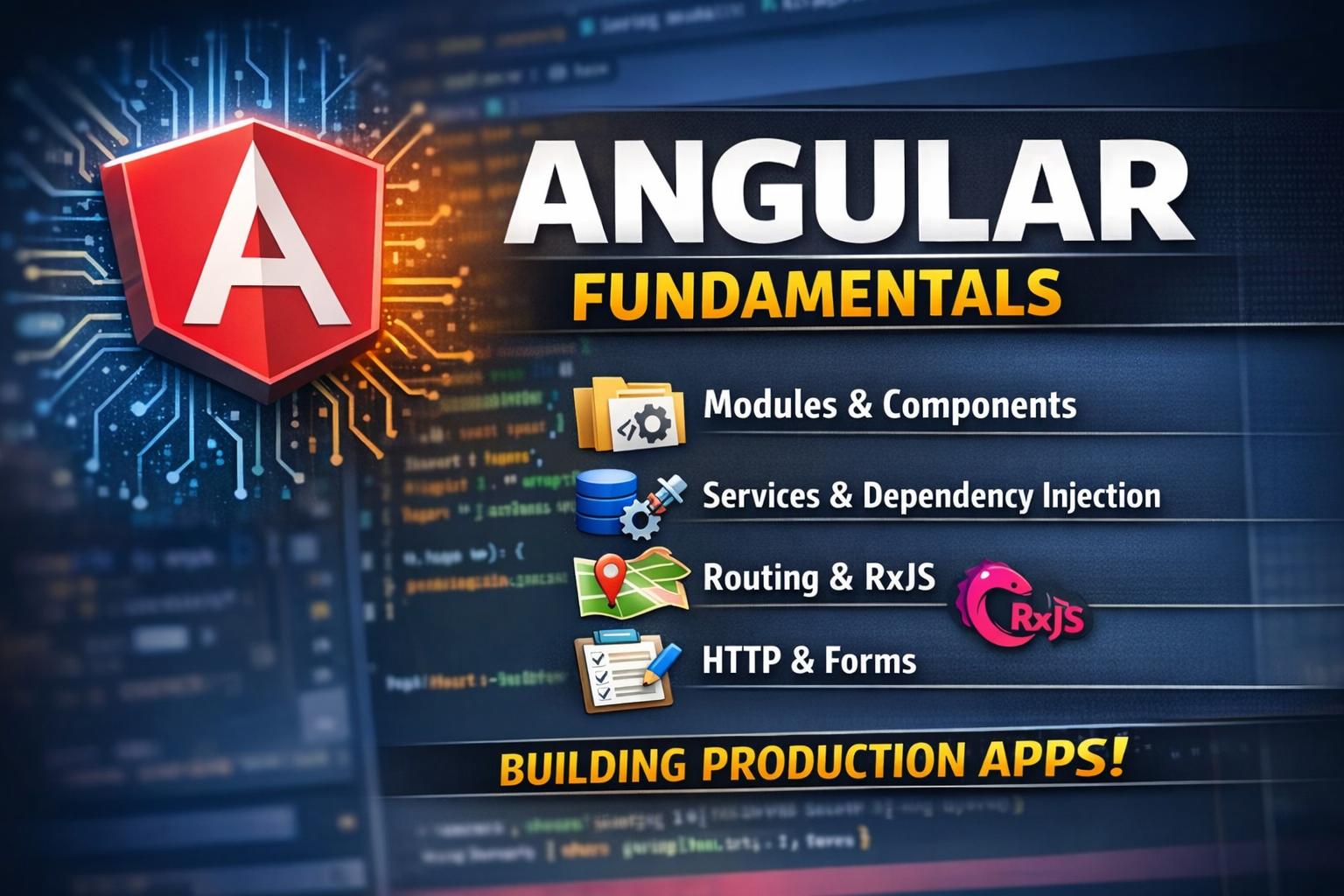
Angular telah menjadi salah satu framework frontend paling comprehensive dan opinionated untuk building large-scale, enterprise-grade web applications. Tapi mengapa Angular ada, dan apa yang membuatnya berbeda dari framework lain? Understanding Angular's philosophy dan core concepts adalah essential untuk building scalable, maintainable, dan production-ready applications.
Dalam artikel ini, kita akan explore Angular's history, understand mengapa Angular diciptakan, dive deep ke core concepts, dan build complete production-ready todo application yang demonstrate semua fundamental Angular patterns.
Sebelum Angular, building large-scale web applications sangat challenging:
Lack of Structure : Tidak ada standardized way untuk organize code dalam large applicationsTwo-Way Binding Issues : Manual synchronization antara model dan view sangat error-proneDependency Management : Managing dependencies antara components sangat complexTesting Difficulty : Testing large applications sangat cumbersome tanpa proper architectureScalability : Applications menjadi difficult to maintain saat growCode Reusability : Sharing logic across components tidak straightforward
Google created Angular (originally AngularJS di 2010, kemudian Angular 2+ di 2016) untuk solve problems ini:
Opinionated Architecture : Provides complete framework dengan clear structure dan patternsTypeScript First : Built dengan TypeScript untuk type safety dan better toolingDependency Injection : Built-in DI container untuk managing dependenciesModular Design : NgModule system untuk organize code ke logical unitsPowerful Templating : Advanced template syntax dengan two-way bindingRxJS Integration : Reactive programming dengan Observables untuk handling async operationsComprehensive Tooling : Angular CLI untuk scaffolding, building, dan testingEnterprise Ready : Designed untuk large teams dan complex applications
Modules adalah containers untuk cohesive block dari code yang dedicated ke application domain, workflow, atau closely related set dari capabilities.
import { NgModule } from '@angular/core' ; import { BrowserModule } from '@angular/platform-browser' ; import { HttpClientModule } from '@angular/common/http' ; import { ReactiveFormsModule } from '@angular/forms' ;
import { AppComponent } from './app.component' ; import { TodoListComponent } from './components/todo-list/todo-list.component' ;
@ NgModule ({ declarations : [ AppComponent , TodoListComponent , ], imports : [ BrowserModule , HttpClientModule , ReactiveFormsModule , ], providers : [], bootstrap : [ AppComponent ], }) export class AppModule { } Components adalah basic building blocks dari Angular applications. Component controls patch dari screen yang disebut view.
Component dengan Decorator import { Component , OnInit , Input , Output , EventEmitter } from '@angular/core' ;
@ Component ({ selector : 'app-todo-item' , template : ` <div class="todo-item"> <input type="checkbox" [checked]="todo.completed" (change)="onToggle()" /> <span [class.completed]="todo.completed">{{ todo.title }}</span> <button (click)="onDelete()">Delete</button> </div> ` , styles : [ ` .todo-item { display: flex; gap: 10px; padding: 10px; border-bottom: 1px solid #eee; } .completed { text-decoration: line-through; color: #999; } ` ], }) export class TodoItemComponent implements OnInit { @ Input () todo : any ; @ Output () toggle = new EventEmitter < void >(); @ Output () delete = new EventEmitter < void >();
ngOnInit () : void { console . log ( 'TodoItemComponent initialized' ); }
onToggle () : void { this . toggle . emit (); }
onDelete () : void { this . delete . emit (); } } Services adalah classes dengan focused purpose. Mereka digunakan untuk share data dan logic across components.
Service dengan Dependency Injection import { Injectable } from '@angular/core' ; import { HttpClient } from '@angular/common/http' ; import { Observable , BehaviorSubject } from 'rxjs' ; import { map , tap } from 'rxjs/operators' ;
export interface Todo { id : string ; title : string ; description : string ; completed : boolean ; priority : 'low' | 'medium' | 'high' ; dueDate : string ; createdAt : Date ; }
@ Injectable ({ providedIn : 'root' , }) export class TodoService { private apiUrl = '/api/todos' ; private todosSubject = new BehaviorSubject < Todo []>([]); public todos$ = this . todosSubject . asObservable ();
constructor ( private http : HttpClient ) { this . loadTodos (); }
loadTodos () : void { this . http . get < Todo []>( this . apiUrl ) . pipe ( tap ( todos => this . todosSubject . next ( todos )) ) . subscribe (); }
getTodos () : Observable < Todo []> { return this . todos$ ; }
addTodo ( todo : Omit < Todo , 'id' | 'createdAt' >) : Observable < Todo > { return this . http . post < Todo >( this . apiUrl , todo ) . pipe ( tap ( newTodo => { const current = this . todosSubject . value ; this . todosSubject . next ([ newTodo , ... current ]); }) ); }
updateTodo ( id : string , updates : Partial < Todo >) : Observable < Todo > { return this . http . patch < Todo >( ` ${ this . apiUrl } / ${ id } ` , updates ) . pipe ( tap ( updated => { const current = this . todosSubject . value ; const index = current . findIndex ( t => t . id === id ); if ( index !== - 1 ) { current [ index ] = updated ; this . todosSubject . next ([ ... current ]); } }) ); }
deleteTodo ( id : string ) : Observable < void > { return this . http . delete < void >( ` ${ this . apiUrl } / ${ id } ` ) . pipe ( tap (() => { const current = this . todosSubject . value ; this . todosSubject . next ( current . filter ( t => t . id !== id )); }) ); } } Directives adalah classes yang add new behavior ke DOM atau modify existing behavior.
Structural dan Attribute Directives import { Directive , ElementRef , HostListener , Input } from '@angular/core' ;
// Structural Directive - modifies DOM structure @ Directive ({ selector : '[appHighlight]' , }) export class HighlightDirective { @ Input () appHighlight = 'yellow' ;
constructor ( private el : ElementRef ) {}
@ HostListener ( 'mouseenter' ) onMouseEnter () : void { this . highlight ( this . appHighlight ); }
@ HostListener ( 'mouseleave' ) onMouseLeave () : void { this . highlight ( 'transparent' ); }
private highlight ( color : string ) : void { this . el . nativeElement . style . backgroundColor = color ; } }
// Usage dalam template // <div appHighlight="lightblue">Hover me</div>
// Built-in Structural Directives // *ngIf - conditionally render // *ngFor - loop through arrays // *ngSwitch - switch between templates
// Template example /* <div *ngIf="isVisible">Visible</div> <div *ngFor="let item of items; let i = index">{{ i }}: {{ item }}</div> <div [ngSwitch]="status"> <div *ngSwitchCase="'active'">Active</div> <div *ngSwitchCase="'inactive'">Inactive</div> <div *ngSwitchDefault>Unknown</div> </div> */ Pipes transform data untuk display dalam templates.
Built-in dan Custom Pipes import { Pipe , PipeTransform } from '@angular/core' ;
// Custom Pipe @ Pipe ({ name : 'truncate' , }) export class TruncatePipe implements PipeTransform { transform ( value : string , limit : number = 50 ) : string { if ( ! value ) return '' ; return value . length > limit ? value . substring ( 0 , limit ) + '...' : value ; } }
// Built-in Pipes /* {{ date | date: 'short' }} {{ price | currency: 'USD' }} {{ text | uppercase }} {{ text | lowercase }} {{ items | slice: 0:5 }} {{ value | number: '1.2-2' }} {{ obj | json }} */
// Template example /* <p>{{ todo.title | truncate: 30 }}</p> <p>{{ todo.dueDate | date: 'MMM d, y' }}</p> <p>{{ todo.priority | uppercase }}</p> */ Angular provides dua approaches untuk handling forms: Reactive Forms dan Template-driven Forms.
import { Component , OnInit } from '@angular/core' ; import { FormBuilder , FormGroup , Validators } from '@angular/forms' ;
@ Component ({ selector : 'app-todo-form' , template : ` <form [formGroup]="form" (ngSubmit)="onSubmit()"> <div> <label>Title</label> <input type="text" formControlName="title" placeholder="Enter task title" /> <div *ngIf="form.get('title')?.invalid && form.get('title')?.touched"> Title is required </div> </div>
<div> <label>Description</label> <textarea formControlName="description" placeholder="Enter task description" ></textarea> </div>
<div> <label>Priority</label> <select formControlName="priority"> <option value="low">Low</option> <option value="medium">Medium</option> <option value="high">High</option> </select> </div>
<div> <label>Due Date</label> <input type="date" formControlName="dueDate" /> </div>
<button type="submit" [disabled]="form.invalid">Add Task</button> </form> ` , }) export class TodoFormComponent implements OnInit { form !: FormGroup ;
constructor ( private fb : FormBuilder ) {}
ngOnInit () : void { this . form = this . fb . group ({ title : [ '' , [ Validators . required , Validators . minLength ( 3 )]], description : [ '' ], priority : [ 'medium' ], dueDate : [ '' ], }); }
onSubmit () : void { if ( this . form . valid ) { console . log ( this . form . value ); this . form . reset (); } } } HttpClient service digunakan untuk communicate dengan backend servers over HTTP.
import { Injectable } from '@angular/core' ; import { HttpClient , HttpHeaders , HttpParams } from '@angular/common/http' ; import { Observable , throwError } from 'rxjs' ; import { catchError , retry , timeout } from 'rxjs/operators' ;
@ Injectable ({ providedIn : 'root' , }) export class ApiService { private apiUrl = 'https://api.example.com' ;
constructor ( private http : HttpClient ) {}
// GET request getTodos () : Observable < any []> { return this . http . get < any []>( ` ${ this . apiUrl } /todos` ) . pipe ( timeout ( 5000 ), retry ( 1 ), catchError ( this . handleError ) ); }
// POST request createTodo ( todo : any ) : Observable < any > { const headers = new HttpHeaders ({ 'Content-Type' : 'application/json' , });
return this . http . post < any >( ` ${ this . apiUrl } /todos` , todo , { headers } ). pipe ( catchError ( this . handleError ) ); }
// PUT request updateTodo ( id : string , todo : any ) : Observable < any > { return this . http . put < any >( ` ${ this . apiUrl } /todos/ ${ id } ` , todo ). pipe ( catchError ( this . handleError ) ); }
// DELETE request deleteTodo ( id : string ) : Observable < void > { return this . http . delete < void >( ` ${ this . apiUrl } /todos/ ${ id } ` ). pipe ( catchError ( this . handleError ) ); }
// Query parameters searchTodos ( query : string ) : Observable < any []> { const params = new HttpParams () . set ( 'q' , query ) . set ( 'limit' , '10' );
return this . http . get < any []>( ` ${ this . apiUrl } /todos/search` , { params } ). pipe ( catchError ( this . handleError ) ); }
private handleError ( error : any ) : Observable < never > { console . error ( 'API Error:' , error ); return throwError (() => new Error ( 'API request failed' )); } } Angular Router enables navigation antara components berdasarkan URL.
import { NgModule } from '@angular/core' ; import { RouterModule , Routes } from '@angular/router' ; import { TodoListComponent } from './components/todo-list/todo-list.component' ; import { TodoDetailComponent } from './components/todo-detail/todo-detail.component' ; import { AuthGuard } from './guards/auth.guard' ;
const routes : Routes = [ { path : '' , redirectTo : '/todos' , pathMatch : 'full' , }, { path : 'todos' , component : TodoListComponent , canActivate : [ AuthGuard ], }, { path : 'todos/:id' , component : TodoDetailComponent , canActivate : [ AuthGuard ], }, { path : '**' , redirectTo : '/todos' , }, ];
@ NgModule ({ imports : [ RouterModule . forRoot ( routes )], exports : [ RouterModule ], }) export class AppRoutingModule { }
// Route Guard import { Injectable } from '@angular/core' ; import { CanActivate , Router } from '@angular/router' ;
@ Injectable ({ providedIn : 'root' , }) export class AuthGuard implements CanActivate { constructor ( private router : Router ) {}
canActivate () : boolean { const isAuthenticated = !! localStorage . getItem ( 'token' ); if ( ! isAuthenticated ) { this . router . navigate ([ '/login' ]); } return isAuthenticated ; } } Observables adalah key part dari Angular untuk handling asynchronous operations.
RxJS Observables dan Operators import { Observable , Subject , BehaviorSubject , interval } from 'rxjs' ; import { map , filter , switchMap , debounceTime , distinctUntilChanged } from 'rxjs/operators' ;
// Creating Observables const observable$ = new Observable ( subscriber => { subscriber . next ( 1 ); subscriber . next ( 2 ); subscriber . next ( 3 ); subscriber . complete (); });
// Subject - multicast observable const subject$ = new Subject < number >(); subject$ . subscribe ( value => console . log ( 'Observer 1:' , value )); subject$ . subscribe ( value => console . log ( 'Observer 2:' , value )); subject$ . next ( 42 );
// BehaviorSubject - always has current value const behaviorSubject$ = new BehaviorSubject < string >( 'initial' ); behaviorSubject$ . subscribe ( value => console . log ( value )); behaviorSubject$ . next ( 'updated' );
// Common Operators const numbers$ = interval ( 1000 ). pipe ( // Transform values map ( x => x * 2 ), // Filter values filter ( x => x > 5 ), // Flatten nested observables switchMap ( x => new Observable ( sub => sub . next ( x * 10 ))), // Debounce rapid emissions debounceTime ( 300 ), // Only emit if value changed distinctUntilChanged () );
// Combining Observables import { combineLatest , merge , forkJoin } from 'rxjs' ;
const combined$ = combineLatest ([ observable1$ , observable2$ ]); const merged$ = merge ( observable1$ , observable2$ ); const forked$ = forkJoin ([ observable1$ , observable2$ ]); Angular's change detection mechanism determines kapan untuk update view.
Change Detection Strategies import { Component , ChangeDetectionStrategy , ChangeDetectorRef } from '@angular/core' ;
// Default Strategy - checks entire component tree @ Component ({ selector : 'app-default' , template : `<p>{{ data }}</p>` , }) export class DefaultComponent { data = 'Initial' ; }
// OnPush Strategy - only checks ketika inputs change atau events occur @ Component ({ selector : 'app-on-push' , template : `<p>{{ data }}</p>` , changeDetection : ChangeDetectionStrategy . OnPush , }) export class OnPushComponent { @ Input () data : string = '' ; }
// Manual Change Detection @ Component ({ selector : 'app-manual' , template : `<p>{{ data }}</p>` , changeDetection : ChangeDetectionStrategy . OnPush , }) export class ManualComponent { data = 'Initial' ;
constructor ( private cdr : ChangeDetectorRef ) {}
updateData () : void { this . data = 'Updated' ; // Manually trigger change detection this . cdr . markForCheck (); } } Mari kita build complete todo management application yang demonstrate semua Angular fundamentals.
todo-app/ ├── src/ │ ├── app/ │ │ ├── models/ │ │ │ └── todo.model.ts │ │ ├── services/ │ │ │ └── todo.service.ts │ │ ├── components/ │ │ │ ├── todo-list/ │ │ │ ├── todo-item/ │ │ │ ├── todo-form/ │ │ │ └── todo-filter/ │ │ ├── app.component.ts │ │ ├── app.module.ts │ │ └── app-routing.module.ts │ ├── styles.css │ └── main.ts ├── angular.json └── package.json src/app/models/todo.model.ts export interface Todo { id : string ; title : string ; description : string ; completed : boolean ; priority : 'low' | 'medium' | 'high' ; dueDate : string ; createdAt : Date ; }
export type FilterType = 'all' | 'active' | 'completed' ;
export interface TodoStats { total : number ; active : number ; completed : number ; } src/app/services/todo.service.ts import { Injectable } from '@angular/core' ; import { HttpClient } from '@angular/common/http' ; import { BehaviorSubject , Observable } from 'rxjs' ; import { tap , catchError } from 'rxjs/operators' ; import { throwError } from 'rxjs' ; import { Todo } from '../models/todo.model' ;
@ Injectable ({ providedIn : 'root' , }) export class TodoService { private apiUrl = '/api/todos' ; private todosSubject = new BehaviorSubject < Todo []>([]); public todos$ = this . todosSubject . asObservable ();
constructor ( private http : HttpClient ) { this . loadTodos (); }
loadTodos () : void { this . http . get < Todo []>( this . apiUrl ) . pipe ( tap ( todos => this . todosSubject . next ( todos )), catchError ( error => { console . error ( 'Error loading todos:' , error ); return throwError (() => error ); }) ) . subscribe (); }
getTodos () : Observable < Todo []> { return this . todos$ ; }
addTodo ( todo : Omit < Todo , 'id' | 'createdAt' >) : Observable < Todo > { return this . http . post < Todo >( this . apiUrl , todo ) . pipe ( tap ( newTodo => { const current = this . todosSubject . value ; this . todosSubject . next ([ newTodo , ... current ]); }), catchError ( error => { console . error ( 'Error adding todo:' , error ); return throwError (() => error ); }) ); }
updateTodo ( id : string , updates : Partial < Todo >) : Observable < Todo > { return this . http . patch < Todo >( ` ${ this . apiUrl } / ${ id } ` , updates ) . pipe ( tap ( updated => { const current = this . todosSubject . value ; const index = current . findIndex ( t => t . id === id ); if ( index !== - 1 ) { current [ index ] = updated ; this . todosSubject . next ([ ... current ]); } }), catchError ( error => { console . error ( 'Error updating todo:' , error ); return throwError (() => error ); }) ); }
deleteTodo ( id : string ) : Observable < void > { return this . http . delete < void >( ` ${ this . apiUrl } / ${ id } ` ) . pipe ( tap (() => { const current = this . todosSubject . value ; this . todosSubject . next ( current . filter ( t => t . id !== id )); }), catchError ( error => { console . error ( 'Error deleting todo:' , error ); return throwError (() => error ); }) ); }
toggleTodo ( id : string ) : Observable < Todo > { const todo = this . todosSubject . value . find ( t => t . id === id ); if ( ! todo ) { return throwError (() => new Error ( 'Todo not found' )); } return this . updateTodo ( id , { completed : ! todo . completed }); } } src/app/components/todo-list/todo-list.component.ts import { Component , OnInit } from '@angular/core' ; import { CommonModule } from '@angular/common' ; import { TodoService } from '../../services/todo.service' ; import { Todo , FilterType , TodoStats } from '../../models/todo.model' ; import { TodoItemComponent } from '../todo-item/todo-item.component' ; import { TodoFormComponent } from '../todo-form/todo-form.component' ; import { TodoFilterComponent } from '../todo-filter/todo-filter.component' ;
@ Component ({ selector : 'app-todo-list' , standalone : true , imports : [ CommonModule , TodoItemComponent , TodoFormComponent , TodoFilterComponent , ], template : ` <div class="todo-container"> <header class="app-header"> <h1>Task Manager</h1> <p>Organize your tasks efficiently</p> </header>
<main class="app-main"> <app-todo-form (taskAdded)="onTaskAdded()"></app-todo-form>
<app-todo-filter [activeFilter]="filter" [stats]="stats" (filterChanged)="onFilterChange($event)" ></app-todo-filter>
<div class="task-list" *ngIf="filteredTodos.length > 0"> <app-todo-item *ngFor="let todo of filteredTodos; trackBy: trackByTodoId" [todo]="todo" (toggle)="onToggleTodo(todo.id)" (delete)="onDeleteTodo(todo.id)" ></app-todo-item> </div>
<div class="empty-state" *ngIf="filteredTodos.length === 0"> <p>No tasks found. {{ filter !== 'all' ? 'Try changing the filter.' : '' }}</p> </div> </main> </div> ` , styles : [ ` .todo-container { max-width: 800px; margin: 0 auto; }
.app-header { text-align: center; color: white; margin-bottom: 40px; }
.app-header h1 { font-size: 2.5rem; margin-bottom: 10px; }
.app-header p { font-size: 1.1rem; opacity: 0.9; }
.app-main { background: white; border-radius: 12px; padding: 30px; box-shadow: 0 20px 60px rgba(0, 0, 0, 0.3); }
.task-list { display: flex; flex-direction: column; gap: 12px; }
.empty-state { text-align: center; padding: 40px 20px; color: #9ca3af; } ` ], }) export class TodoListComponent implements OnInit { todos : Todo [] = []; filter : FilterType = 'all' ; stats : TodoStats = { total : 0 , active : 0 , completed : 0 };
get filteredTodos () : Todo [] { return this . todos . filter ( todo => { if ( this . filter === 'active' ) return ! todo . completed ; if ( this . filter === 'completed' ) return todo . completed ; return true ; }); }
constructor ( private todoService : TodoService ) {}
ngOnInit () : void { this . todoService . getTodos (). subscribe ( todos => { this . todos = todos ; this . updateStats (); }); }
onTaskAdded () : void { this . todoService . loadTodos (); }
onToggleTodo ( id : string ) : void { this . todoService . toggleTodo ( id ). subscribe (); }
onDeleteTodo ( id : string ) : void { this . todoService . deleteTodo ( id ). subscribe (); }
onFilterChange ( filter : FilterType ) : void { this . filter = filter ; }
private updateStats () : void { this . stats = { total : this . todos . length , active : this . todos . filter ( t => ! t . completed ). length , completed : this . todos . filter ( t => t . completed ). length , }; }
trackByTodoId ( index : number , todo : Todo ) : string { return todo . id ; } } src/app/components/todo-item/todo-item.component.ts import { Component , Input , Output , EventEmitter } from '@angular/core' ; import { CommonModule } from '@angular/common' ; import { Todo } from '../../models/todo.model' ;
@ Component ({ selector : 'app-todo-item' , standalone : true , imports : [ CommonModule ], template : ` <div class="task-item" [class.completed]="todo.completed"> <div class="task-content"> <input type="checkbox" [checked]="todo.completed" (change)="onToggle()" class="task-checkbox" />
<div class="task-details"> <h3 class="task-title">{{ todo.title }}</h3> <p class="task-description" *ngIf="todo.description"> {{ todo.description }} </p>
<div class="task-meta"> <span class="priority-badge" [style.backgroundColor]="getPriorityColor(todo.priority)" > {{ todo.priority }} </span>
<span class="due-date" *ngIf="todo.dueDate"> Due: {{ todo.dueDate | date: 'MMM d, y' }} </span> </div> </div> </div>
<button (click)="onDelete()" class="btn btn-danger btn-small"> Delete </button> </div> ` , styles : [ ` .task-item { display: flex; justify-content: space-between; align-items: center; padding: 15px; background: #f9fafb; border-radius: 8px; border-left: 4px solid #667eea; transition: all 0.2s; }
.task-item:hover { background: #f3f4f6; box-shadow: 0 2px 8px rgba(0, 0, 0, 0.1); }
.task-item.completed { opacity: 0.6; border-left-color: #10b981; }
.task-item.completed .task-title { text-decoration: line-through; color: #9ca3af; }
.task-content { display: flex; gap: 12px; flex: 1; }
.task-checkbox { width: 20px; height: 20px; cursor: pointer; margin-top: 2px; }
.task-details { flex: 1; }
.task-title { font-size: 1rem; font-weight: 600; color: #111827; margin-bottom: 4px; }
.task-description { font-size: 0.875rem; color: #6b7280; margin-bottom: 8px; }
.task-meta { display: flex; gap: 10px; align-items: center; }
.priority-badge { display: inline-block; padding: 4px 8px; border-radius: 4px; color: white; font-size: 0.75rem; font-weight: 600; }
.due-date { font-size: 0.875rem; color: #6b7280; }
.btn { padding: 10px 20px; border: none; border-radius: 6px; font-size: 1rem; font-weight: 600; cursor: pointer; transition: all 0.2s; }
.btn-danger { background: #ef4444; color: white; }
.btn-danger:hover { background: #dc2626; }
.btn-small { padding: 6px 12px; font-size: 0.875rem; } ` ], }) export class TodoItemComponent { @ Input () todo !: Todo ; @ Output () toggle = new EventEmitter < void >(); @ Output () delete = new EventEmitter < void >();
onToggle () : void { this . toggle . emit (); }
onDelete () : void { this . delete . emit (); }
getPriorityColor ( priority : string ) : string { const colors : Record < string , string > = { low : '#3b82f6' , medium : '#f59e0b' , high : '#ef4444' , }; return colors [ priority ] || '#3b82f6' ; } } src/app/components/todo-form/todo-form.component.ts import { Component , Output , EventEmitter } from '@angular/core' ; import { CommonModule } from '@angular/common' ; import { ReactiveFormsModule , FormBuilder , FormGroup , Validators } from '@angular/forms' ; import { TodoService } from '../../services/todo.service' ;
@ Component ({ selector : 'app-todo-form' , standalone : true , imports : [ CommonModule , ReactiveFormsModule ], template : ` <form [formGroup]="form" (ngSubmit)="onSubmit()" class="task-form"> <div class="form-group"> <label for="title">Task Title *</label> <input id="title" type="text" formControlName="title" placeholder="Enter task title" class="form-input" /> <div class="error" *ngIf="form.get('title')?.invalid && form.get('title')?.touched"> Title is required and must be at least 3 characters </div> </div>
<div class="form-group"> <label for="description">Description</label> <textarea id="description" formControlName="description" placeholder="Enter task description" class="form-input" rows="3" ></textarea> </div>
<div class="form-row"> <div class="form-group"> <label for="priority">Priority</label> <select id="priority" formControlName="priority" class="form-input"> <option value="low">Low</option> <option value="medium">Medium</option> <option value="high">High</option> </select> </div>
<div class="form-group"> <label for="dueDate">Due Date</label> <input id="dueDate" type="date" formControlName="dueDate" class="form-input" /> </div> </div>
<button type="submit" [disabled]="form.invalid" class="btn btn-primary"> Add Task </button> </form> ` , styles : [ ` .task-form { margin-bottom: 30px; padding-bottom: 30px; border-bottom: 2px solid #e5e7eb; }
.form-group { margin-bottom: 15px; }
.form-group label { display: block; margin-bottom: 5px; font-weight: 600; color: #374151; }
.form-input { width: 100%; padding: 10px 12px; border: 1px solid #d1d5db; border-radius: 6px; font-size: 1rem; transition: border-color 0.2s; }
.form-input:focus { outline: none; border-color: #667eea; box-shadow: 0 0 0 3px rgba(102, 126, 234, 0.1); }
.form-row { display: grid; grid-template-columns: 1fr 1fr; gap: 15px; }
.btn { padding: 10px 20px; border: none; border-radius: 6px; font-size: 1rem; font-weight: 600; cursor: pointer; transition: all 0.2s; }
.btn-primary { background: #667eea; color: white; width: 100%; }
.btn-primary:hover:not(:disabled) { background: #5568d3; transform: translateY(-2px); box-shadow: 0 4px 12px rgba(102, 126, 234, 0.4); }
.btn-primary:disabled { opacity: 0.5; cursor: not-allowed; }
.error { color: #ef4444; font-size: 0.875rem; margin-top: 4px; }
@media (max-width: 640px) { .form-row { grid-template-columns: 1fr; } } ` ], }) export class TodoFormComponent { @ Output () taskAdded = new EventEmitter < void >(); form : FormGroup ;
constructor ( private fb : FormBuilder , private todoService : TodoService ) { this . form = this . fb . group ({ title : [ '' , [ Validators . required , Validators . minLength ( 3 )]], description : [ '' ], priority : [ 'medium' ], dueDate : [ '' ], }); }
onSubmit () : void { if ( this . form . valid ) { this . todoService . addTodo ( this . form . value ). subscribe ({ next : () => { this . form . reset ({ priority : 'medium' }); this . taskAdded . emit (); }, error : ( error ) => { console . error ( 'Error adding task:' , error ); }, }); } } } src/app/components/todo-filter/todo-filter.component.ts import { Component , Input , Output , EventEmitter } from '@angular/core' ; import { CommonModule } from '@angular/common' ; import { FilterType , TodoStats } from '../../models/todo.model' ;
@ Component ({ selector : 'app-todo-filter' , standalone : true , imports : [ CommonModule ], template : ` <div class="task-filter"> <div class="filter-buttons"> <button *ngFor="let filterOption of filters" (click)="onFilterChange(filterOption)" [class.active]="activeFilter === filterOption" class="filter-btn" > {{ filterOption | titlecase }} </button> </div>
<div class="filter-stats"> <span>Total: {{ stats.total }}</span> <span>Active: {{ stats.active }}</span> <span>Completed: {{ stats.completed }}</span> </div> </div> ` , styles : [ ` .task-filter { display: flex; justify-content: space-between; align-items: center; margin-bottom: 25px; padding: 15px; background: #f9fafb; border-radius: 8px; }
.filter-buttons { display: flex; gap: 10px; }
.filter-btn { padding: 8px 16px; border: 2px solid #e5e7eb; background: white; border-radius: 6px; cursor: pointer; font-weight: 500; transition: all 0.2s; }
.filter-btn.active { border-color: #667eea; background: #667eea; color: white; }
.filter-stats { display: flex; gap: 20px; font-size: 0.875rem; color: #6b7280; }
@media (max-width: 640px) { .task-filter { flex-direction: column; gap: 15px; align-items: flex-start; }
.filter-stats { width: 100%; justify-content: space-around; } } ` ], }) export class TodoFilterComponent { @ Input () activeFilter : FilterType = 'all' ; @ Input () stats : TodoStats = { total : 0 , active : 0 , completed : 0 }; @ Output () filterChanged = new EventEmitter < FilterType >();
filters : FilterType [] = [ 'all' , 'active' , 'completed' ];
onFilterChange ( filter : FilterType ) : void { this . filterChanged . emit ( filter ); } } import { Component } from '@angular/core' ; import { CommonModule } from '@angular/common' ; import { RouterOutlet } from '@angular/router' ; import { TodoListComponent } from './components/todo-list/todo-list.component' ;
@ Component ({ selector : 'app-root' , standalone : true , imports : [ CommonModule , RouterOutlet , TodoListComponent ], template : ` <div class="app-wrapper"> <app-todo-list></app-todo-list> </div> ` , styles : [ ` .app-wrapper { min-height: 100vh; background: linear-gradient(135deg, #667eea 0%, #764ba2 100%); padding: 20px; } ` ], }) export class AppComponent { title = 'todo-app' ; } * { margin: 0 ; padding: 0 ; box-sizing: border-box ; }
html , body { height: 100 % ; }
body { font-family: -apple-system , BlinkMacSystemFont, 'Segoe UI' , 'Roboto' , 'Oxygen' , 'Ubuntu' , 'Cantarell' , 'Fira Sans' , 'Droid Sans' , 'Helvetica Neue' , sans-serif ; -webkit-font-smoothing : antialiased ; -moz-osx-font-smoothing : grayscale ; }
app-root { display: block ; }
/* Scrollbar Styling */ ::-webkit-scrollbar { width: 8 px ; height: 8 px ; }
::-webkit-scrollbar-track { background: # f1f1f1 ; }
::-webkit-scrollbar-thumb { background: # 888 ; border-radius: 4 px ; }
::-webkit-scrollbar-thumb:hover { background: # 555 ; }
/* Focus Styles */ :focus-visible { outline: 2 px solid # 667eea ; outline-offset: 2 px ; }
/* Animations */ @keyframes fadeIn { from { opacity: 0 ; transform: translateY ( 10 px ); } to { opacity: 1 ; transform: translateY ( 0 ); } }
@keyframes slideIn { from { transform: translateX ( -100 % ); } to { transform: translateX ( 0 ); } }
/* Utility Classes */ .container { max-width: 1200 px ; margin: 0 auto ; padding: 0 20 px ; }
.text-center { text-align: center ; }
.mt-1 { margin-top: 0.5 rem ; } .mt-2 { margin-top: 1 rem ; } .mt-3 { margin-top: 1.5 rem ; } .mt-4 { margin-top: 2 rem ; }
.mb-1 { margin-bottom: 0.5 rem ; } .mb-2 { margin-bottom: 1 rem ; } .mb-3 { margin-bottom: 1.5 rem ; } .mb-4 { margin-bottom: 2 rem ; }
.p-1 { padding: 0.5 rem ; } .p-2 { padding: 1 rem ; } .p-3 { padding: 1.5 rem ; } .p-4 { padding: 2 rem ; } // ✅ Keep components small dan focused // ✅ Use OnPush change detection untuk performance // ✅ Implement OnDestroy untuk clean up subscriptions // ✅ Use trackBy dalam *ngFor untuk performance // ✅ Prefer composition over inheritance // ✅ Use standalone components ketika possible // ✅ Separate concerns: template, logic, styles
@ Component ({ selector : 'app-user-card' , template : `...` , changeDetection : ChangeDetectionStrategy . OnPush , }) export class UserCardComponent implements OnInit , OnDestroy { @ Input () user !: User ; private destroy$ = new Subject < void >();
ngOnInit () : void { // Subscribe dengan takeUntil }
ngOnDestroy () : void { this . destroy$ . next (); this . destroy$ . complete (); } } // ✅ Use providedIn: 'root' untuk singleton services // ✅ Separate API calls dari business logic // ✅ Use BehaviorSubject untuk state management // ✅ Handle errors consistently // ✅ Use typed responses // ✅ Implement proper error handling
@ Injectable ({ providedIn : 'root' , }) export class DataService { private dataSubject = new BehaviorSubject < Data []>([]); public data$ = this . dataSubject . asObservable ();
constructor ( private http : HttpClient ) {}
loadData () : void { this . http . get < Data []>( '/api/data' ) . pipe ( catchError ( error => { console . error ( 'Error loading data:' , error ); return of ([]); }) ) . subscribe ( data => this . dataSubject . next ( data )); } } // ✅ Use async pipe dalam templates // ✅ Unsubscribe properly dengan takeUntil // ✅ Use shareReplay untuk expensive operations // ✅ Combine observables dengan combineLatest // ✅ Use switchMap untuk dependent requests
export class SearchComponent { searchTerm$ = new Subject < string >(); results$ = this . searchTerm$ . pipe ( debounceTime ( 300 ), distinctUntilChanged (), switchMap ( term => this . api . search ( term )), shareReplay ( 1 ) );
constructor ( private api : ApiService ) {} }
// Template // <div *ngFor="let result of results$ | async">{{ result }}</div> // ✅ Use Reactive Forms untuk complex forms // ✅ Validate on blur, bukan pada setiap keystroke // ✅ Show validation errors hanya ketika touched // ✅ Use custom validators untuk business logic // ✅ Disable submit button saat form invalid
@ Component ({ selector : 'app-form' , template : ` <form [formGroup]="form"> <input formControlName="email" /> <div *ngIf="form.get('email')?.invalid && form.get('email')?.touched"> Invalid email </div> <button [disabled]="form.invalid">Submit</button> </form> ` , }) export class FormComponent { form = this . fb . group ({ email : [ '' , [ Validators . required , Validators . email ]], });
constructor ( private fb : FormBuilder ) {} } // ✅ Test component behavior, bukan implementation // ✅ Use TestBed untuk component testing // ✅ Mock services dan HTTP calls // ✅ Test user interactions // ✅ Aim untuk high coverage
import { ComponentFixture , TestBed } from '@angular/core/testing' ; import { TodoComponent } from './todo.component' ;
describe ( 'TodoComponent' , () => { let component : TodoComponent ; let fixture : ComponentFixture < TodoComponent >;
beforeEach ( async () => { await TestBed . configureTestingModule ({ declarations : [ TodoComponent ], }). compileComponents ();
fixture = TestBed . createComponent ( TodoComponent ); component = fixture . componentInstance ; fixture . detectChanges (); });
it ( 'should create' , () => { expect ( component ). toBeTruthy (); });
it ( 'should add todo' , () => { component . addTodo ( 'Test' ); expect ( component . todos . length ). toBe ( 1 ); }); }); export class BadComponent implements OnInit { constructor ( private service : DataService ) {}
ngOnInit () : void { // ❌ Never unsubscribed - memory leak! this . service . getData (). subscribe ( data => { console . log ( data ); }); } }
// ✅ Correct - Using takeUntil export class GoodComponent implements OnInit , OnDestroy { private destroy$ = new Subject < void >();
constructor ( private service : DataService ) {}
ngOnInit () : void { this . service . getData () . pipe ( takeUntil ( this . destroy$ )) . subscribe ( data => console . log ( data )); }
ngOnDestroy () : void { this . destroy$ . next (); this . destroy$ . complete (); } } ❌ Wrong - Performance Issue // ❌ Default strategy checks entire tree pada setiap event @ Component ({ selector : 'app-item' , template : `<p>{{ item.name }}</p>` , }) export class ItemComponent { @ Input () item : any ; }
// ✅ Correct - OnPush hanya checks ketika inputs change @ Component ({ selector : 'app-item' , template : `<p>{{ item.name }}</p>` , changeDetection : ChangeDetectionStrategy . OnPush , }) export class ItemComponent { @ Input () item : any ; } ❌ Wrong - Manual Subscription export class BadComponent { data : any ;
constructor ( private service : DataService ) {}
ngOnInit () : void { // ❌ Manual subscription, need to unsubscribe this . service . getData (). subscribe ( data => { this . data = data ; }); } }
// ✅ Correct - Using async pipe export class GoodComponent { data$ = this . service . getData ();
constructor ( private service : DataService ) {} }
// Template // <p>{{ data$ | async }}</p> ❌ Wrong - No Error Handling // ❌ No error handling this . http . get ( '/api/data' ). subscribe ( data => { this . data = data ; });
// ✅ Correct - Proper error handling this . http . get ( '/api/data' ). pipe ( catchError ( error => { console . error ( 'Error:' , error ); return of ([]); // Return default value }) ). subscribe ( data => { this . data = data ; }); ❌ Wrong - New Observable Each Render // ❌ Creates new observable pada setiap change detection export class BadComponent { constructor ( private service : DataService ) {}
getData () { return this . service . getData (); // Called every render! } }
// Template // <div *ngFor="let item of getData() | async">{{ item }}</div>
// ✅ Correct - Observable created once export class GoodComponent { data$ = this . service . getData ();
constructor ( private service : DataService ) {} }
// Template // <div *ngFor="let item of data$ | async">{{ item }}</div> Angular adalah powerful, comprehensive framework yang designed untuk building large-scale, enterprise-grade web applications. Understanding core concepts-nya—modules, components, services, dependency injection, directives, pipes, forms, HTTP, routing, RxJS, dan change detection—adalah fundamental untuk menjadi proficient Angular developer.
Todo management application yang kita build demonstrate semua concepts ini dalam action. Dengan mastering fundamentals ini dan following best practices, kamu akan able untuk build scalable, maintainable, dan performant Angular applications.
Key takeaways:
Angular provides complete, opinionated framework untuk large applications
Modules organize code ke logical, reusable units
Components adalah building blocks dengan clear separation of concerns
Services dan DI enable code reusability dan testability
RxJS dan Observables handle asynchronous operations elegantly
Reactive Forms provide powerful form handling capabilities
Change detection strategy significantly impacts performance
Proper error handling dan subscription management prevent bugs
Testing adalah built into Angular's architecture
Following best practices leads ke maintainable, scalable code
Next steps:
Build small projects untuk practice fundamentals
Learn state management dengan NgRx atau Akita
Explore advanced patterns (smart/dumb components, facade pattern)
Master performance optimization techniques
Learn testing strategies dengan Jasmine dan Karma
Explore Angular Universal untuk server-side rendering
Study security best practices (XSS, CSRF protection)
Learn deployment strategies dan CI/CD integration
Angular adalah journey, bukan destination. Keep learning, building, dan improving your skills. Framework terus evolve, dan staying updated dengan new features dan best practices akan make you a better developer.