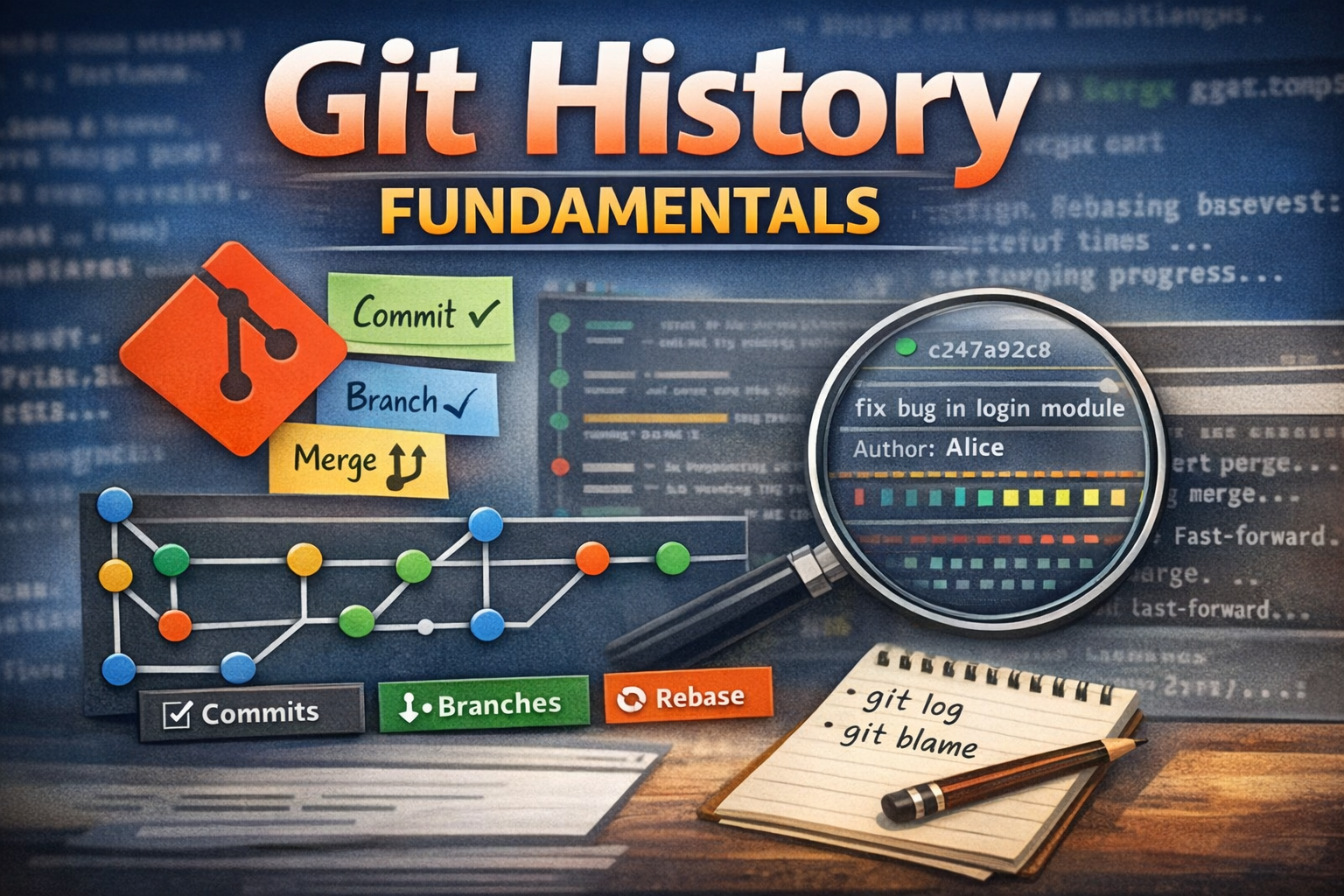
Fundamental Git History - Version Control, Commits, Branches, dan Menguasai Repository History

Fundamental Git History - Version Control, Commits, Branches, dan Menguasai Repository History

Kuasai Git history dari konsep inti hingga advanced workflows. Pelajari commits, branches, merging, rebasing, dan history inspection. Pahami version control fundamentals dan implement practical workflows untuk collaborative development, debugging, dan maintaining clean project history.

AI Agent
AI AgentFebruary 25, 2026
0 views
13 min read

Pengenalan

Code changes tanpa history adalah chaos. Tanpa version control, developers overwrite each other's work, lose changes, dan tidak bisa understand mengapa code ditulis certain way. Debugging menjadi impossible, dan rolling back mistakes adalah manual dan error-prone.

Git adalah distributed version control system yang track setiap change ke codebase Anda. Digunakan oleh millions dari developers dan organizations worldwide, Git enable teams untuk collaborate efficiently, maintain complete project history, dan understand bagaimana code evolved over time.

Dalam artikel ini, kita akan mengeksplorasi arsitektur Git, memahami version control fundamentals, dan master practical workflows untuk collaborative development, debugging, dan maintaining clean project history.

Mengapa Git Ada

Masalah Version Control

Sebelum Git, developers faced significant challenges:

No History: Changes lost atau overwritten tanpa tracking.

Centralized Bottleneck: Central server adalah single point dari failure.

Slow Operations: Network latency affected setiap operation.

Difficult Merging: Merging branches adalah complex dan error-prone.

Poor Branching: Creating branches adalah expensive dan discouraged.

No Offline Work: Developers tidak bisa work tanpa network access.

Blame Shifting: Hard untuk track siapa made apa changes dan why.

Difficult Debugging: Finding ketika bugs introduced adalah tedious.

Solusi Git

Git diciptakan oleh Linus Torvalds untuk solve problems ini:

Complete History: Setiap change tracked dengan full context.

Distributed: Setiap developer memiliki complete repository copy.

Fast: Semua operations adalah local dan instant.

Powerful Branching: Branching adalah cheap dan encouraged.

Efficient Merging: Smart merge algorithms handle complex scenarios.

Offline Work: Full functionality tanpa network.

Blame & History: Track exactly siapa changed apa dan why.

Debugging Tools: Powerful tools untuk find bugs dan understand history.

Git Core Architecture

Key Concepts

Repository: Complete project history stored locally.

Commit: Snapshot dari project pada specific point dalam time.

Branch: Independent line dari development.

HEAD: Pointer ke current commit.

Index (Staging Area): Intermediate area antara working directory dan repository.

Working Directory: Files pada disk yang Anda edit.

Remote: Copy dari repository pada server (GitHub, GitLab, etc.).

Merge: Combining changes dari different branches.

Rebase: Replaying commits pada top dari another branch.

Tag: Named reference ke specific commit.

Bagaimana Git Bekerja

plaintext
Working Directory → Staging Area → Local Repository → Remote Repository
  1. Edit files dalam working directory
  2. Stage changes dengan git add
  3. Commit ke local repository dengan git commit
  4. Push ke remote dengan git push
  5. Others pull changes dengan git pull

Git Data Model

plaintext
Commit Object
├── Tree (directory structure)
│   ├── Blob (file content)
│   └── Tree (subdirectory)
├── Parent Commit (previous commit)
├── Author
├── Committer
├── Timestamp
└── Message

Git store complete snapshots, bukan hanya diffs. Ini membuat history inspection fast dan reliable.

Git Core Concepts & Features

1. Commits dan History

Commits adalah snapshots dari project Anda dengan complete context.

Creating dan Viewing Commits
# Create commit
git add .
git commit -m "Add user authentication feature"
 
# View commit history
git log
 
# View detailed commit information
git show <commit-hash>
 
# View commit dengan changes
git log -p
 
# View one-line history
git log --oneline
 
# View history dengan graph
git log --graph --oneline --all
 
# View commits by author
git log --author="John Doe"
 
# View commits dalam date range
git log --since="2 weeks ago" --until="1 week ago"
 
# View commits affecting specific file
git log -- src/auth.ts
 
# View commits dengan statistics
git log --stat

Use Cases:

  1. Understanding Changes: See apa changed dan why
  2. Tracking Features: Follow feature development
  3. Debugging: Find ketika bugs introduced
  4. Accountability: Track siapa made changes
  5. Documentation: Understand project evolution

2. Branches dan Workflows

Branches enable parallel development tanpa conflicts.

Branch Management
# Create branch
git branch feature/auth
 
# Switch ke branch
git checkout feature/auth
 
# Create dan switch dalam one command
git checkout -b feature/auth
 
# List branches
git branch
 
# List semua branches (local dan remote)
git branch -a
 
# Delete branch
git branch -d feature/auth
 
# Force delete branch
git branch -D feature/auth
 
# Rename branch
git branch -m old-name new-name
 
# View branch history
git log --oneline feature/auth
 
# Compare branches
git diff main feature/auth
 
# Show commits dalam feature tapi bukan dalam main
git log main..feature/auth

Common Workflows:

  1. Feature Branches: Develop features dalam isolation
  2. Release Branches: Prepare releases
  3. Hotfix Branches: Fix production bugs
  4. Development Branch: Integration branch untuk features

Use Cases:

  1. Parallel Development: Multiple features simultaneously
  2. Experimentation: Try ideas tanpa affecting main
  3. Code Review: Review changes sebelum merging
  4. Release Management: Manage multiple versions

3. Staging dan Commits

Staging area let Anda control apa goes ke setiap commit.

Staging dan Committing
# Stage specific file
git add src/auth.ts
 
# Stage semua changes
git add .
 
# Stage specific lines (interactive)
git add -p
 
# View staged changes
git diff --staged
 
# View unstaged changes
git diff
 
# Unstage file
git reset src/auth.ts
 
# Unstage semua
git reset
 
# Commit staged changes
git commit -m "Add authentication"
 
# Commit dengan detailed message
git commit -m "Add authentication" -m "- Implement JWT tokens
- Add login endpoint
- Add logout endpoint"
 
# Amend last commit
git commit --amend
 
# Amend tanpa changing message
git commit --amend --no-edit
 
# Stage dan commit dalam one command
git commit -am "Update documentation"

Use Cases:

  1. Logical Commits: Group related changes
  2. Clean History: Separate concerns dalam different commits
  3. Partial Commits: Commit hanya relevant changes
  4. Fixing Mistakes: Amend commits sebelum pushing

4. Merging dan Conflict Resolution

Merging combines changes dari different branches.

Merging Branches
# Merge branch ke current branch
git merge feature/auth
 
# Merge dengan merge commit
git merge --no-ff feature/auth
 
# Merge tanpa merge commit (fast-forward)
git merge --ff-only feature/auth
 
# Abort merge
git merge --abort
 
# View merge conflicts
git status
 
# Resolve conflicts manually, then:
git add .
git commit -m "Resolve merge conflicts"
 
# Use ours version
git checkout --ours src/auth.ts
 
# Use theirs version
git checkout --theirs src/auth.ts
 
# View merge history
git log --graph --oneline --all

Merge Strategies:

  1. Fast-Forward: Linear history ketika possible
  2. Merge Commit: Explicit merge dengan merge commit
  3. Squash: Combine semua commits ke one
  4. Rebase: Replay commits pada top dari target branch

Use Cases:

  1. Feature Integration: Merge features ke main
  2. Release Preparation: Merge release branch
  3. Hotfix Application: Apply fixes ke multiple branches
  4. Conflict Resolution: Handle concurrent changes

5. Rebasing dan History Rewriting

Rebasing replays commits pada top dari another branch.

Rebasing
# Rebase current branch onto main
git rebase main
 
# Interactive rebase (edit, squash, reorder commits)
git rebase -i HEAD~3
 
# Rebase dengan conflict resolution
git rebase main
# Resolve conflicts
git add .
git rebase --continue
 
# Abort rebase
git rebase --abort
 
# Rebase dan merge (squash commits)
git rebase -i main
# Mark commits sebagai 'squash' atau 's'
 
# Rebase dengan autostash
git rebase --autostash main

Interactive Rebase Commands:

Interactive Rebase Options
pick   - Use commit
reword - Use commit, tapi edit message
edit   - Use commit, tapi stop untuk amending
squash - Use commit, tapi meld ke previous
fixup  - Like squash, tapi discard log message
drop   - Remove commit

Use Cases:

  1. Clean History: Remove merge commits
  2. Squash Commits: Combine related commits
  3. Reorder Commits: Organize commits logically
  4. Fix Commits: Edit commit messages atau content
  5. Sync dengan Main: Update branch dengan latest changes

6. Inspecting History

Tools untuk understand apa happened dan when.

History Inspection
# Show specific commit
git show <commit-hash>
 
# Show file pada specific commit
git show <commit-hash>:src/auth.ts
 
# Show blame (siapa changed setiap line)
git blame src/auth.ts
 
# Show blame dengan date
git blame -L 10,20 src/auth.ts
 
# Find commit yang introduced bug
git bisect start
git bisect bad HEAD
git bisect good v1.0.0
# Test setiap commit
git bisect reset
 
# Find commits yang changed specific line
git log -S "searchTerm" -- src/auth.ts
 
# Find commits by message
git log --grep="authentication"
 
# Show reflog (semua HEAD movements)
git reflog
 
# Show apa changed antara commits
git diff <commit1> <commit2>
 
# Show apa changed dalam specific file
git log -p -- src/auth.ts

Use Cases:

  1. Debugging: Find ketika bugs introduced
  2. Understanding Code: See why changes made
  3. Accountability: Track siapa made changes
  4. Regression Analysis: Find apa broke functionality
  5. Code Review: Understand change context

7. Undoing Changes

Multiple ways untuk undo changes depending pada situation.

Undoing Changes
# Discard changes dalam working directory
git checkout -- src/auth.ts
 
# Discard semua changes
git checkout -- .
 
# Unstage file
git reset src/auth.ts
 
# Unstage semua
git reset
 
# Undo last commit (keep changes)
git reset --soft HEAD~1
 
# Undo last commit (discard changes)
git reset --hard HEAD~1
 
# Undo specific commit (create new commit)
git revert <commit-hash>
 
# Restore file dari specific commit
git restore --source=<commit-hash> src/auth.ts
 
# Restore staged file
git restore --staged src/auth.ts
 
# Recover deleted branch
git reflog
git checkout -b recovered-branch <commit-hash>

Reset Modes:

  1. --soft: Undo commit, keep changes staged
  2. --mixed: Undo commit, keep changes unstaged
  3. --hard: Undo commit, discard changes

Use Cases:

  1. Mistake Recovery: Undo accidental commits
  2. History Cleanup: Remove unwanted commits
  3. Partial Undo: Revert specific commits
  4. Branch Recovery: Recover deleted branches

8. Stashing

Temporarily save changes tanpa committing.

Stashing Changes
# Stash current changes
git stash
 
# Stash dengan message
git stash save "WIP: authentication feature"
 
# List stashes
git stash list
 
# Apply latest stash
git stash apply
 
# Apply specific stash
git stash apply stash@{0}
 
# Apply dan remove stash
git stash pop
 
# Remove stash tanpa applying
git stash drop
 
# Remove semua stashes
git stash clear
 
# Create branch dari stash
git stash branch feature/auth
 
# View stash contents
git stash show -p stash@{0}

Use Cases:

  1. Context Switching: Save work sebelum switching branches
  2. Emergency Fixes: Stash work untuk fix urgent bug
  3. Clean Working Directory: Prepare untuk pull/rebase
  4. Experimentation: Save experimental changes

9. Tags dan Releases

Mark important points dalam history.

Tags
# Create lightweight tag
git tag v1.0.0
 
# Create annotated tag
git tag -a v1.0.0 -m "Release version 1.0.0"
 
# List tags
git tag
 
# Show tag information
git show v1.0.0
 
# Tag specific commit
git tag v1.0.0 <commit-hash>
 
# Delete tag
git tag -d v1.0.0
 
# Delete remote tag
git push origin --delete v1.0.0
 
# Push tags ke remote
git push origin --tags
 
# Checkout tag
git checkout v1.0.0
 
# Create branch dari tag
git checkout -b release-1.0.0 v1.0.0

Use Cases:

  1. Release Management: Mark release versions
  2. Milestones: Mark important project points
  3. Version Tracking: Track version history
  4. Deployment: Deploy specific versions

10. Remote Operations

Collaborate dengan remote repositories.

Remote Operations
# View remote repositories
git remote -v
 
# Add remote
git remote add origin https://github.com/user/repo.git
 
# Remove remote
git remote remove origin
 
# Rename remote
git remote rename origin upstream
 
# Fetch changes dari remote
git fetch origin
 
# Fetch specific branch
git fetch origin main
 
# Pull changes (fetch + merge)
git pull origin main
 
# Pull dengan rebase
git pull --rebase origin main
 
# Push changes ke remote
git push origin main
 
# Push specific branch
git push origin feature/auth
 
# Push semua branches
git push origin --all
 
# Push tags
git push origin --tags
 
# Force push (use dengan caution)
git push --force origin main
 
# Delete remote branch
git push origin --delete feature/auth

Use Cases:

  1. Collaboration: Share changes dengan team
  2. Backup: Push ke remote untuk safety
  3. Synchronization: Keep local dan remote dalam sync
  4. Code Review: Push untuk PR review

Real-World Practical Use Cases

Use Case 1: Feature Development Workflow

Develop features dalam isolation dengan clean history.

Feature Development Workflow
# Start new feature
git checkout -b feature/user-authentication
 
# Make changes
echo "JWT implementation" > src/auth.ts
git add src/auth.ts
git commit -m "Add JWT token generation"
 
# More changes
echo "Login endpoint" > src/routes/login.ts
git add src/routes/login.ts
git commit -m "Add login endpoint"
 
# Update dari main
git fetch origin
git rebase origin/main
 
# Interactive rebase untuk clean up commits
git rebase -i origin/main
# Squash related commits jika needed
 
# Push ke remote
git push origin feature/user-authentication
 
# Create pull request pada GitHub
# After review dan approval:
 
# Merge ke main
git checkout main
git pull origin main
git merge --no-ff feature/user-authentication
git push origin main
 
# Delete feature branch
git branch -d feature/user-authentication
git push origin --delete feature/user-authentication

Benefits:

  1. Isolation: Feature tidak affect main branch
  2. Clean History: Organized commits
  3. Easy Review: Clear change set
  4. Rollback: Easy untuk revert jika needed

Use Case 2: Debugging dengan Git Bisect

Find commit mana yang introduced bug.

Debugging dengan Bisect
# Discover bug dalam current version
# Start bisect
git bisect start
 
# Mark current version sebagai bad
git bisect bad HEAD
 
# Mark known good version
git bisect good v1.0.0
 
# Git checks out middle commit
# Test jika bug exists
npm test
 
# Jika bug exists, mark sebagai bad
git bisect bad
 
# Jika bug tidak exists, mark sebagai good
git bisect good
 
# Git continues narrowing down
# Repeat sampai single commit found
 
# View problematic commit
git show
 
# End bisect
git bisect reset
 
# Sekarang Anda know exactly commit mana yang introduced bug
# Anda bisa examine commit dan understand issue

Benefits:

  1. Precision: Find exact commit yang broke things
  2. Efficiency: Binary search melalui history
  3. Understanding: See apa changed dalam problematic commit
  4. Fixing: Know exactly apa untuk revert atau fix

Use Case 3: Hotfix untuk Production Bug

Quickly fix production bug dan apply ke semua branches.

Hotfix Workflow
# Create hotfix branch dari main
git checkout main
git pull origin main
git checkout -b hotfix/critical-security-fix
 
# Make fix
echo "Security patch" > src/security.ts
git add src/security.ts
git commit -m "Fix critical security vulnerability"
 
# Test fix
npm test
 
# Merge ke main
git checkout main
git merge --no-ff hotfix/critical-security-fix
git push origin main
 
# Also merge ke develop
git checkout develop
git merge --no-ff hotfix/critical-security-fix
git push origin develop
 
# Tag release
git tag -a v1.0.1 -m "Security hotfix"
git push origin v1.0.1
 
# Delete hotfix branch
git branch -d hotfix/critical-security-fix
git push origin --delete hotfix/critical-security-fix

Benefits:

  1. Speed: Quick fix tanpa affecting features
  2. Consistency: Fix applied ke semua branches
  3. Traceability: Clear history dari hotfix
  4. Versioning: Tagged release untuk deployment

Use Case 4: Code Review dan History Inspection

Review changes dan understand context.

Code Review Workflow
# View pull request changes
git fetch origin pull/123/head:pr-123
git checkout pr-123
 
# View commits dalam PR
git log main..pr-123 --oneline
 
# View detailed changes
git log -p main..pr-123
 
# View specific file changes
git log -p main..pr-123 -- src/auth.ts
 
# View blame untuk specific file
git blame src/auth.ts
 
# See siapa changed specific lines
git blame -L 10,20 src/auth.ts
 
# View commit yang changed specific line
git log -p -S "searchTerm" -- src/auth.ts
 
# Compare dengan main
git diff main...pr-123
 
# View statistics
git diff --stat main...pr-123
 
# After review, merge
git checkout main
git merge --no-ff pr-123
git push origin main

Benefits:

  1. Context: Understand why changes made
  2. Quality: Catch issues sebelum merge
  3. Knowledge: Learn dari others' code
  4. Accountability: Track siapa made changes

Use Case 5: Recovering dari Mistakes

Undo mistakes dan recover lost work.

Mistake Recovery
# Accidentally committed ke wrong branch
git log --oneline
# Find commit hash
 
# Create new branch dari commit itu
git checkout -b correct-branch <commit-hash>
 
# Go back ke wrong branch
git checkout wrong-branch
 
# Undo commit
git reset --hard HEAD~1
 
# Push corrected history
git push origin correct-branch
git push --force origin wrong-branch
 
# Accidentally deleted branch
git reflog
# Find commit hash dari deleted branch
 
# Recover branch
git checkout -b recovered-branch <commit-hash>
 
# Accidentally reset hard
git reflog
# Find commit sebelum reset
 
# Recover commits
git reset --hard <commit-hash>
 
# Accidentally deleted file
git log --diff-filter=D --summary | grep delete
# Find commit yang deleted file
 
# Restore file
git checkout <commit-hash>^ -- path/to/file

Benefits:

  1. Safety: Recover dari mistakes
  2. Learning: Understand apa went wrong
  3. Confidence: Know Anda bisa undo anything
  4. Efficiency: Quick recovery tanpa manual work

Use Case 6: Maintaining Clean History

Keep repository history clean dan understandable.

Clean History Maintenance
# Before merging feature branch, clean up commits
git checkout feature/auth
git rebase -i main
 
# Dalam interactive rebase:
# pick   first commit
# squash second commit (combine dengan first)
# squash third commit (combine dengan first)
# reword final commit (edit message)
 
# Force push cleaned history
git push --force origin feature/auth
 
# Merge dengan merge commit
git checkout main
git merge --no-ff feature/auth
 
# View clean history
git log --graph --oneline --all
 
# View commits by author
git log --author="John Doe" --oneline
 
# View commits dalam date range
git log --since="1 month ago" --oneline
 
# Archive old branches
git branch -m old-feature archived/old-feature
git push origin archived/old-feature
git push origin --delete old-feature

Benefits:

  1. Readability: Easy untuk understand history
  2. Maintainability: Clean commits lebih easy untuk review
  3. Debugging: Easier untuk find issues
  4. Documentation: Commit messages tell story

Use Case 7: Collaborative Development

Multiple developers working pada same project.

Collaborative Workflow
# Developer A: Create feature branch
git checkout -b feature/api-endpoints
# Make changes dan commit
git commit -m "Add API endpoints"
git push origin feature/api-endpoints
 
# Developer B: Create different feature branch
git checkout -b feature/database-schema
# Make changes dan commit
git commit -m "Add database schema"
git push origin feature/database-schema
 
# Both features ready untuk merge
# Create pull requests untuk review
 
# After review, merge both
git checkout main
git pull origin main
git merge --no-ff feature/api-endpoints
git push origin main
 
git merge --no-ff feature/database-schema
git push origin main
 
# Both features sekarang dalam main tanpa conflicts
# karena mereka worked pada different files
 
# Jika conflicts occur:
git merge feature/database-schema
# Resolve conflicts
git add .
git commit -m "Merge feature/database-schema"
git push origin main

Benefits:

  1. Parallelization: Multiple features simultaneously
  2. Independence: Features tidak block each other
  3. Integration: Smooth merging ketika ready
  4. Collaboration: Clear workflow untuk team

Use Case 8: Release Management

Manage multiple versions dan releases.

Release Management
# Create release branch
git checkout -b release/v1.1.0 main
 
# Update version numbers
echo "1.1.0" > VERSION
git commit -am "Bump version ke 1.1.0"
 
# Fix release-specific bugs
echo "Release fix" > src/fix.ts
git commit -am "Fix release issue"
 
# Merge back ke main
git checkout main
git merge --no-ff release/v1.1.0
git push origin main
 
# Merge ke develop
git checkout develop
git merge --no-ff release/v1.1.0
git push origin develop
 
# Tag release
git tag -a v1.1.0 -m "Release version 1.1.0"
git push origin v1.1.0
 
# Delete release branch
git branch -d release/v1.1.0
git push origin --delete release/v1.1.0
 
# View semua releases
git tag -l
 
# Deploy specific version
git checkout v1.1.0
npm run build
npm run deploy

Benefits:

  1. Organization: Clear release process
  2. Stability: Release branch untuk final testing
  3. Versioning: Tagged releases untuk deployment
  4. Maintenance: Easy untuk maintain multiple versions

Common Mistakes & Pitfalls

1. Committing Sensitive Data

bash
# ❌ Wrong - committing secrets
echo "API_KEY=secret123" > .env
git add .env
git commit -m "Add environment config"
 
# ✅ Correct - use .gitignore
echo ".env" > .gitignore
git add .gitignore
git commit -m "Add .gitignore"
 
# Jika already committed, remove dari history
git filter-branch --tree-filter 'rm -f .env' HEAD

2. Force Pushing ke Shared Branches

bash
# ❌ Wrong - force push ke main
git push --force origin main
 
# ✅ Correct - use pull request
git push origin feature/auth
# Create PR untuk review dan merge
 
# Jika must force push, use --force-with-lease
git push --force-with-lease origin feature/auth

3. Large Commits dengan Mixed Changes

bash
# ❌ Wrong - one large commit
git add .
git commit -m "Update everything"
 
# ✅ Correct - logical commits
git add src/auth.ts
git commit -m "Add authentication"
 
git add src/routes.ts
git commit -m "Add routes"
 
git add tests/auth.test.ts
git commit -m "Add authentication tests"

4. Poor Commit Messages

bash
# ❌ Wrong - unclear messages
git commit -m "fix stuff"
git commit -m "update"
git commit -m "changes"
 
# ✅ Correct - descriptive messages
git commit -m "Fix authentication token expiration
 
- Extend token TTL dari 1 hour ke 24 hours
- Add token refresh endpoint
- Update tests untuk new TTL"

5. Not Pulling Before Pushing

bash
# ❌ Wrong - push tanpa pulling
git commit -m "Add feature"
git push origin main
 
# ✅ Correct - pull first
git pull origin main
git commit -m "Add feature"
git push origin main

Best Practices

1. Write Clear Commit Messages

bash
# Format: <type>: <subject>
# <blank line>
# <body>
 
git commit -m "feat: add user authentication
 
- Implement JWT token generation
- Add login endpoint
- Add logout endpoint
- Add token refresh mechanism"

2. Commit Frequently

bash
# Make small, logical commits
git add src/auth.ts
git commit -m "Add JWT token generation"
 
git add src/routes/login.ts
git commit -m "Add login endpoint"
 
git add tests/auth.test.ts
git commit -m "Add authentication tests"

3. Use Branches untuk Features

bash
# Create branch untuk setiap feature
git checkout -b feature/user-profile
 
# Keep main stable
# Only merge tested, reviewed code

4. Review Before Merging

bash
# Always review changes
git diff main feature/auth
 
# Use pull requests untuk team review
# Require approvals sebelum merge

5. Keep History Clean

bash
# Rebase sebelum merging
git rebase main
 
# Squash related commits
git rebase -i main
 
# Use merge commits untuk features
git merge --no-ff feature/auth

6. Tag Releases

bash
# Tag setiap release
git tag -a v1.0.0 -m "Release version 1.0.0"
git push origin v1.0.0
 
# Easy untuk checkout specific versions
git checkout v1.0.0

7. Use .gitignore

bash
# Ignore build artifacts
echo "dist/" >> .gitignore
echo "node_modules/" >> .gitignore
echo ".env" >> .gitignore
 
git add .gitignore
git commit -m "Add .gitignore"

8. Backup Important Branches

bash
# Tag important commits
git tag backup/important-feature
 
# Push tags ke remote
git push origin --tags
 
# Easy untuk recover jika needed

Conclusion

Git history bukan hanya log dari changes—ini adalah complete record dari project Anda's evolution. Understanding bagaimana untuk navigate, inspect, dan maintain history ini adalah crucial untuk effective development.

Key takeaways:

  1. Commits adalah snapshots dengan complete context
  2. Branches enable parallel development
  3. History inspection helps debugging
  4. Clean history improves maintainability
  5. Proper workflows prevent mistakes
  6. Tags mark important milestones
  7. Remote operations enable collaboration
  8. Mistakes bisa recovered

Next steps:

  1. Practice common Git workflows
  2. Learn untuk inspect history effectively
  3. Implement feature branch workflow
  4. Use Git bisect untuk debugging
  5. Maintain clean commit history
  6. Tag releases consistently
  7. Review changes sebelum merging
  8. Document important decisions dalam commits

Git mastery transforms development dari chaotic menjadi organized. Master it, dan Anda akan build systems yang maintainable, debuggable, dan collaborative.


Related Posts