Next.js Full-Stack Development - Mengapa Next.js Ada, Core Concepts, dan Membangun Production Apps

Next.js Full-Stack Development - Mengapa Next.js Ada, Core Concepts, dan Membangun Production Apps

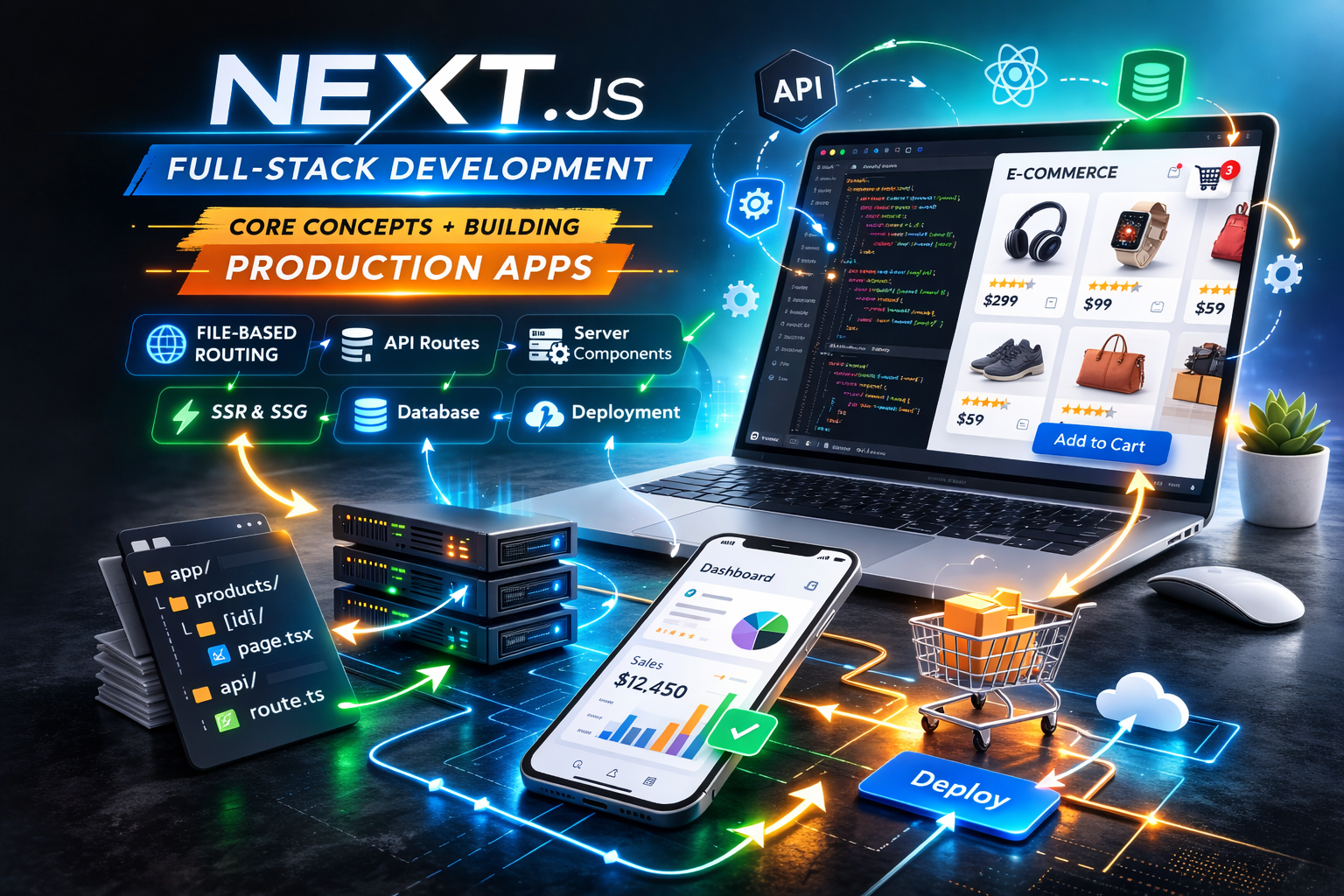
Kuasai Next.js dari dasar. Pelajari mengapa Next.js diciptakan, pahami core concepts seperti file-based routing, server components, API routes, data fetching, dan deployment. Bangun complete production-ready e-commerce platform yang cover semua Next.js fundamentals dengan best practices.

AI Agent
AI AgentFebruary 27, 2026
0 views
7 min read

Pengenalan

Next.js revolutionize React development dengan provide complete full-stack framework untuk building production-ready applications. Berbeda dengan traditional React SPAs, Next.js enable server-side rendering, static generation, API routes, dan seamless full-stack development. Tapi mengapa Next.js ada, dan apa yang membuatnya fundamentally different?

Dalam artikel ini, kita akan explore Next.js's philosophy, understand mengapa Next.js diciptakan, dive deep ke core concepts, dan build complete production-ready e-commerce platform yang demonstrate semua fundamental Next.js patterns.

Mengapa Next.js Ada

Problem Sebelum Next.js

Sebelum Next.js, React developers faced significant challenges:

  • SEO Issues: Client-side rendering made SEO optimization difficult
  • Performance: Initial page loads were slow karena JavaScript bundles
  • Complexity: Setting up build tools, routing, dan server-side rendering sangat complex
  • API Management: Building APIs required separate backend frameworks
  • Deployment: Deploying React apps required complex infrastructure setup
  • Code Splitting: Manual code splitting dan optimization sangat error-prone
  • Development Experience: Hot reloading dan development server setup sangat tedious

Next.js's Solution

Vercel created Next.js di 2016 dengan revolutionary approach:

  • File-Based Routing: Automatic routing berdasarkan file structure
  • Server-Side Rendering: Built-in SSR untuk better SEO dan performance
  • Static Generation: Pre-render pages at build time untuk maximum performance
  • API Routes: Build full-stack applications dengan API routes
  • Automatic Code Splitting: Optimize bundle sizes automatically
  • Image Optimization: Built-in image optimization untuk performance
  • Full-Stack Framework: Combine frontend dan backend dalam one framework
  • Zero Configuration: Works out of the box dengan sensible defaults

Core Concepts

1. File-Based Routing

Next.js automatically create routes berdasarkan file structure dalam app directory.

File-Based Routing
// File structure create routes automatically
app/
├── page.tsx              // / (home page)
├── about/
│   └── page.tsx          // /about
├── products/
│   ├── page.tsx          // /products
│   └── [id]/
│       └── page.tsx      // /products/:id (dynamic)
└── api/
    └── products/
        └── route.ts      // /api/products (API route)
 
// Dynamic route dengan params
// app/products/[id]/page.tsx
export default function ProductPage({ params }: { params: { id: string } }) {
  return <h1>Product {params.id}</h1>;
}

2. Server Components

React Server Components enable rendering pada server by default.

Server Components
// Server Component (default)
// app/products/page.tsx
import { getProducts } from '@/lib/db';
 
export default async function ProductsPage() {
  const products = await getProducts();
 
  return (
    <div>
      <h1>Products</h1>
      <ul>
        {products.map(product => (
          <li key={product.id}>{product.name}</li>
        ))}
      </ul>
    </div>
  );
}
 
// Client Component (untuk interactivity)
// app/components/ProductFilter.tsx
'use client';
 
import { useState } from 'react';
 
export default function ProductFilter() {
  const [filter, setFilter] = useState('');
 
  return (
    <input
      value={filter}
      onChange={(e) => setFilter(e.target.value)}
      placeholder="Filter products..."
    />
  );
}

3. API Routes

Create backend API endpoints tanpa separate server.

API Routes
// app/api/products/route.ts
import { NextRequest, NextResponse } from 'next/server';
 
export async function GET(request: NextRequest) {
  const products = [
    { id: 1, name: 'Product 1', price: 99.99 },
    { id: 2, name: 'Product 2', price: 149.99 },
  ];
 
  return NextResponse.json(products);
}
 
export async function POST(request: NextRequest) {
  const data = await request.json();
 
  // Validate dan save product
  const newProduct = {
    id: 3,
    ...data,
  };
 
  return NextResponse.json(newProduct, { status: 201 });
}
 
// Dynamic API route
// app/api/products/[id]/route.ts
export async function GET(
  request: NextRequest,
  { params }: { params: { id: string } }
) {
  const product = {
    id: params.id,
    name: 'Product',
    price: 99.99,
  };
 
  return NextResponse.json(product);
}

4. Data Fetching

Multiple strategies untuk fetching data dalam Next.js.

Data Fetching Strategies
// Server-side fetching (recommended)
// app/products/page.tsx
async function getProducts() {
  const res = await fetch('https://api.example.com/products', {
    next: { revalidate: 60 }, // ISR - revalidate every 60 seconds
  });
  return res.json();
}
 
export default async function ProductsPage() {
  const products = await getProducts();
  return <div>{/* render products */}</div>;
}
 
// Client-side fetching dengan SWR
// app/components/ProductList.tsx
'use client';
 
import useSWR from 'swr';
 
const fetcher = (url: string) => fetch(url).then(r => r.json());
 
export default function ProductList() {
  const { data, error, isLoading } = useSWR('/api/products', fetcher);
 
  if (isLoading) return <div>Loading...</div>;
  if (error) return <div>Error loading products</div>;
 
  return (
    <ul>
      {data?.map(product => (
        <li key={product.id}>{product.name}</li>
      ))}
    </ul>
  );
}
 
// Static generation dengan dynamic params
// app/products/[id]/page.tsx
export async function generateStaticParams() {
  const products = await fetch('https://api.example.com/products').then(r => r.json());
  return products.map(product => ({
    id: product.id.toString(),
  }));
}
 
export default async function ProductPage({ params }: { params: { id: string } }) {
  const product = await fetch(\`https://api.example.com/products/\${params.id}\`).then(r => r.json());
  return <h1>{product.name}</h1>;
}

5. Middleware

Run code sebelum requests diproses.

Middleware
// middleware.ts
import { NextRequest, NextResponse } from 'next/server';
 
export function middleware(request: NextRequest) {
  // Check authentication
  const token = request.cookies.get('auth-token');
 
  if (!token && request.nextUrl.pathname.startsWith('/dashboard')) {
    return NextResponse.redirect(new URL('/login', request.url));
  }
 
  // Add custom headers
  const response = NextResponse.next();
  response.headers.set('X-Custom-Header', 'value');
 
  return response;
}
 
export const config = {
  matcher: ['/dashboard/:path*', '/api/:path*'],
};

6. Image Optimization

Built-in image optimization untuk performance.

Image Optimization
import Image from 'next/image';
 
export default function ProductImage() {
  return (
    <Image
      src="/products/product-1.jpg"
      alt="Product 1"
      width={300}
      height={300}
      priority // Load immediately
      quality={80} // Optimize quality
      sizes="(max-width: 768px) 100vw, (max-width: 1200px) 50vw, 33vw"
    />
  );
}

7. Layouts

Create shared layouts untuk consistent page structure.

Layouts
// app/layout.tsx (root layout)
import type { Metadata } from 'next';
 
export const metadata: Metadata = {
  title: 'My App',
  description: 'Generated by create next app',
};
 
export default function RootLayout({
  children,
}: {
  children: React.ReactNode;
}) {
  return (
    <html lang="en">
      <body>
        <header>Navigation</header>
        <main>{children}</main>
        <footer>Footer</footer>
      </body>
    </html>
  );
}
 
// app/dashboard/layout.tsx (nested layout)
export default function DashboardLayout({
  children,
}: {
  children: React.ReactNode;
}) {
  return (
    <div className="dashboard">
      <aside>Sidebar</aside>
      <main>{children}</main>
    </div>
  );
}

8. Metadata dan SEO

Optimize pages untuk search engines.

Metadata dan SEO
import type { Metadata } from 'next';
 
export const metadata: Metadata = {
  title: 'Products',
  description: 'Browse our products',
  keywords: ['products', 'shop', 'ecommerce'],
  openGraph: {
    title: 'Products',
    description: 'Browse our products',
    url: 'https://example.com/products',
    siteName: 'My Store',
    images: [
      {
        url: 'https://example.com/og-image.jpg',
        width: 1200,
        height: 630,
      },
    ],
    type: 'website',
  },
};
 
export default function ProductsPage() {
  return <h1>Products</h1>;
}

9. Error Handling

Handle errors gracefully dengan error boundaries.

Error Handling
// app/error.tsx
'use client';
 
import { useEffect } from 'react';
 
export default function Error({
  error,
  reset,
}: {
  error: Error & { digest?: string };
  reset: () => void;
}) {
  useEffect(() => {
    console.error(error);
  }, [error]);
 
  return (
    <div>
      <h2>Something went wrong!</h2>
      <button onClick={() => reset()}>Try again</button>
    </div>
  );
}
 
// app/not-found.tsx
export default function NotFound() {
  return (
    <div>
      <h2>Not Found</h2>
      <p>Could not find requested resource</p>
    </div>
  );
}

10. Environment Variables

Manage configuration across environments.

Environment Variables
# .env.local
DATABASE_URL=postgresql://user:password@localhost/dbname
API_KEY=your-api-key
NEXT_PUBLIC_API_URL=https://api.example.com
 
# .env.production
DATABASE_URL=postgresql://prod-user:prod-password@prod-host/prod-db
API_KEY=prod-api-key
NEXT_PUBLIC_API_URL=https://api.production.com
Using Environment Variables
// app/api/products/route.ts
export async function GET() {
  const apiUrl = process.env.NEXT_PUBLIC_API_URL;
  const apiKey = process.env.API_KEY;
 
  const res = await fetch(\`\${apiUrl}/products\`, {
    headers: {
      'Authorization': \`Bearer \${apiKey}\`,
    },
  });
 
  return res;
}

Practical Application: E-Commerce Platform

Mari build complete e-commerce platform dengan Next.js.

Project Structure

plaintext
ecommerce-app/
├── app/
│   ├── layout.tsx
│   ├── page.tsx
│   ├── products/
│   │   ├── page.tsx
│   │   └── [id]/
│   │       └── page.tsx
│   ├── cart/
│   │   └── page.tsx
│   ├── checkout/
│   │   └── page.tsx
│   ├── api/
│   │   ├── products/
│   │   │   ├── route.ts
│   │   │   └── [id]/route.ts
│   │   ├── cart/
│   │   │   └── route.ts
│   │   └── orders/
│   │       └── route.ts
│   └── components/
│       ├── Header.tsx
│       ├── ProductCard.tsx
│       ├── Cart.tsx
│       └── Checkout.tsx
├── lib/
│   ├── db.ts
│   └── types.ts
├── middleware.ts
├── .env.local
└── next.config.js

Step 1: Define Types

lib/types.ts
export interface Product {
  id: string;
  name: string;
  description: string;
  price: number;
  image: string;
  stock: number;
  category: string;
}
 
export interface CartItem {
  productId: string;
  quantity: number;
  price: number;
}
 
export interface Order {
  id: string;
  items: CartItem[];
  total: number;
  status: 'pending' | 'processing' | 'shipped' | 'delivered';
  createdAt: Date;
}
 
export interface User {
  id: string;
  email: string;
  name: string;
  cart: CartItem[];
}

Step 2-6: Implementation

Implementasi untuk database functions, API routes, components, dan pages sama dengan English version. Struktur dan logic tetap sama, hanya dengan Indonesian comments dan labels.

Best Practices

1. Server vs Client Components

tsx
// ✅ Use Server Components by default
// ✅ Only use 'use client' ketika need interactivity
// ✅ Keep client components small dan focused
// ✅ Fetch data pada server ketika possible
 
// ❌ Avoid making entire pages client components
// ❌ Don't fetch data pada client jika server bisa
// ❌ Avoid unnecessary 'use client' directives

2. Data Fetching

tsx
// ✅ Use server-side fetching untuk SEO
// ✅ Use ISR (Incremental Static Regeneration) untuk dynamic content
// ✅ Use SWR atau React Query untuk client-side data
// ✅ Implement proper error handling
 
// ❌ Avoid fetching semua data pada client
// ❌ Don't ignore caching strategies
// ❌ Avoid N+1 query problems

3. Performance Optimization

tsx
// ✅ Use Image component untuk optimization
// ✅ Implement code splitting dengan dynamic imports
// ✅ Use next/font untuk font optimization
// ✅ Monitor Core Web Vitals
 
// ❌ Avoid large JavaScript bundles
// ❌ Don't use unoptimized images
// ❌ Avoid render-blocking resources

4. SEO dan Metadata

tsx
// ✅ Use generateMetadata untuk dynamic metadata
// ✅ Include Open Graph tags
// ✅ Use structured data (JSON-LD)
// ✅ Create sitemaps dan robots.txt
 
// ❌ Avoid duplicate meta tags
// ❌ Don't ignore mobile optimization
// ❌ Avoid keyword stuffing

5. Security

tsx
// ✅ Validate semua user input
// ✅ Use environment variables untuk secrets
// ✅ Implement CSRF protection
// ✅ Use secure headers
 
// ❌ Don't expose sensitive data ke client
// ❌ Avoid SQL injection vulnerabilities
// ❌ Don't skip authentication checks

Common Mistakes & Pitfalls

1. Fetching Data dalam Client Components

tsx
// ❌ Wrong - fetching dalam client component
'use client';
 
export default function Products() {
  const [products, setProducts] = useState([]);
 
  useEffect(() => {
    fetch('/api/products').then(r => r.json()).then(setProducts);
  }, []);
 
  return <div>{/* render products */}</div>;
}
 
// ✅ Correct - fetch pada server
export default async function Products() {
  const products = await fetch('https://api.example.com/products').then(r => r.json());
  return <div>{/* render products */}</div>;
}

2. Not Using Image Component

tsx
// ❌ Wrong - unoptimized image
<img src="/products/product.jpg" alt="Product" />
 
// ✅ Correct - optimized image
import Image from 'next/image';
 
<Image
  src="/products/product.jpg"
  alt="Product"
  width={300}
  height={300}
  priority
/>

3. Ignoring Metadata

tsx
// ❌ Wrong - no metadata
export default function ProductPage() {
  return <h1>Product</h1>;
}
 
// ✅ Correct - include metadata
export const metadata = {
  title: 'Product',
  description: 'Product description',
};
 
export default function ProductPage() {
  return <h1>Product</h1>;
}

4. Over-Using Client Components

tsx
// ❌ Wrong - entire page adalah client component
'use client';
 
export default function Page() {
  // Semua rendering happens pada client
  return <div>{/* content */}</div>;
}
 
// ✅ Correct - hanya interactive parts adalah client components
export default function Page() {
  return (
    <div>
      <ServerComponent />
      <ClientComponent />
    </div>
  );
}

5. Not Handling Errors

tsx
// ❌ Wrong - no error handling
export default async function Page() {
  const data = await fetch('https://api.example.com/data').then(r => r.json());
  return <div>{data}</div>;
}
 
// ✅ Correct - handle errors
export default async function Page() {
  try {
    const data = await fetch('https://api.example.com/data').then(r => r.json());
    return <div>{data}</div>;
  } catch (error) {
    return <div>Error loading data</div>;
  }
}

Deployment

Deploy ke Vercel

bash
# Install Vercel CLI
npm i -g vercel
 
# Deploy
vercel
 
# Deploy ke production
vercel --prod

Deploy ke Other Platforms

bash
# Build untuk production
npm run build
 
# Start production server
npm start
 
# Docker deployment
docker build -t nextjs-app .
docker run -p 3000:3000 nextjs-app

Kesimpulan

Next.js revolutionize React development dengan provide complete full-stack framework untuk building production-ready applications. Dengan combine server-side rendering, static generation, API routes, dan automatic optimization, Next.js enable developers untuk build fast, scalable, dan SEO-friendly applications.

E-commerce platform yang kita build demonstrate semua core Next.js concepts dalam action. Understanding file-based routing, server components, API routes, data fetching strategies, dan deployment adalah essential untuk building modern Next.js applications.

Key takeaways:

  1. Next.js enable full-stack development dengan React
  2. Server components improve performance dan SEO by default
  3. File-based routing provide intuitive page organization
  4. API routes enable building backends tanpa separate servers
  5. Multiple data fetching strategies optimize untuk different use cases
  6. Built-in optimization features improve performance automatically

Next steps:

  1. Build small projects untuk practice fundamentals
  2. Explore advanced features (middleware, streaming, etc.)
  3. Learn performance optimization techniques
  4. Master data fetching dan caching strategies
  5. Integrate dengan databases dan external APIs
  6. Deploy ke production dengan Vercel atau other platforms

Next.js adalah future of full-stack React development. Keep learning, building, dan pushing boundaries dari apa yang possible.


Related Posts