#Project Overview
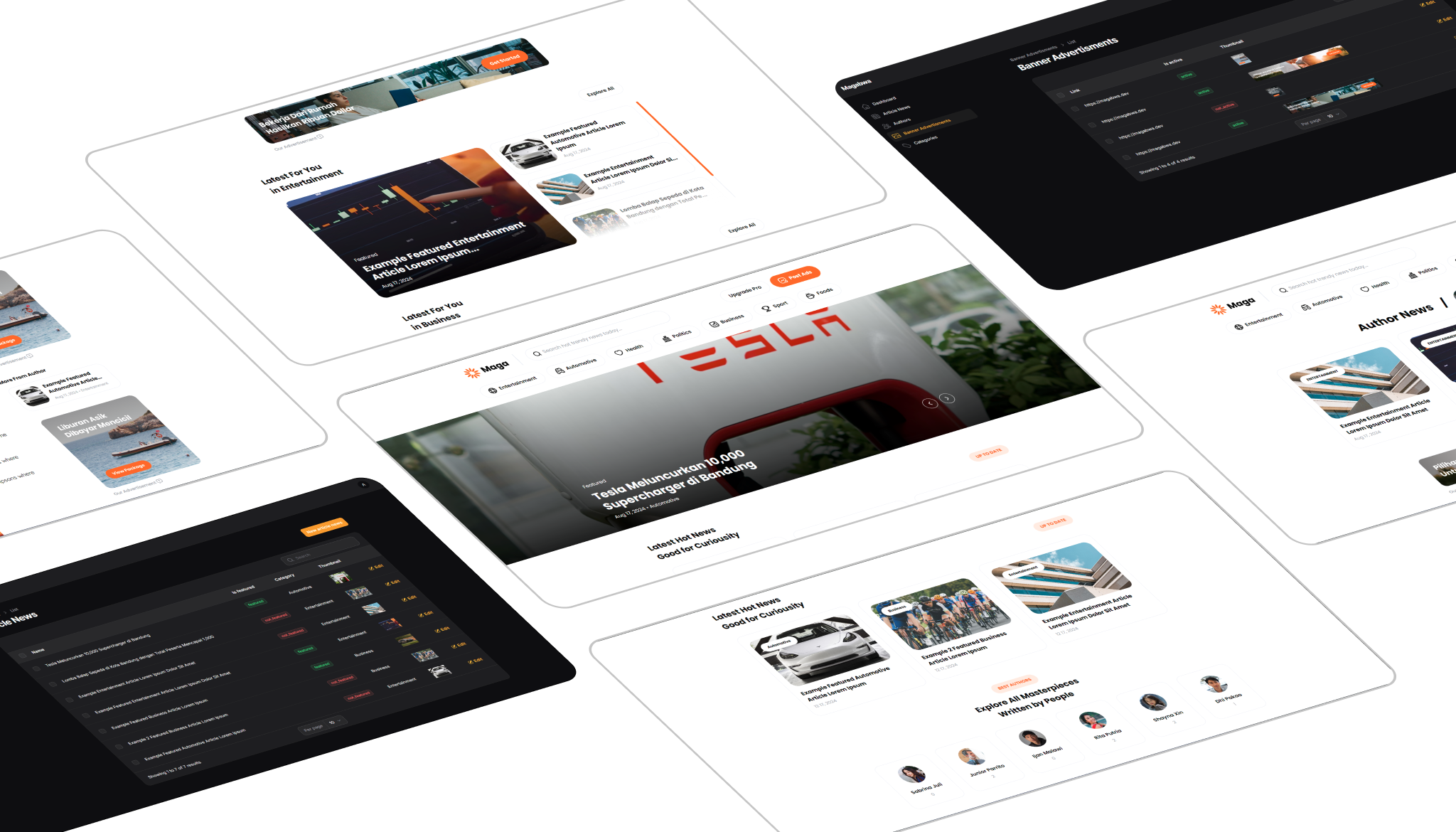
Magabwa is a web application designed as a blogging and article publishing platform. The application functions as a Content Management System (CMS) that allows users to create, manage, and publish blog content through a modern and structured interface.
This project was developed as part of a learning course from buildwithangga.com, with a primary focus on building a CMS using Laravel and Filament as the admin panel for managing blog content.
#Background & Motivation
Magabwa was created to deepen my understanding of building content-driven web applications, particularly CMS-based systems that are commonly used for blogs, documentation platforms, and publishing websites.
Through this course project, I wanted to:
- Learn how a CMS is structured in a real-world Laravel application
- Explore Filament as a modern admin panel solution
- Build a maintainable and scalable blog management system
- Go beyond the tutorial by experimenting with deployment-related tooling
As with my previous projects, I did not stop at the course material and continued to explore additional aspects independently.
#Application Concept
Magabwa is designed as a blog / article platform, where the CMS handles:
- Content creation and management
- Blog post publishing
- Admin-side content operations through a clean UI
Filament plays a central role in simplifying the management of blog content by providing a powerful and developer-friendly admin interface.
#Key Features
#Content Management System (CMS)
- Admin panel built using Filament
- Create, edit, and delete blog posts
- Structured content management workflow
#Blog Platform
- Public-facing blog pages
- Content-driven architecture
- Clean and modern UI using Tailwind CSS
#Improvisation Beyond the Course Material
While the course focused on building the CMS functionality using Laravel and Filament, Docker and Nginx were not part of the official course scope.
These components were added as part of my personal experimentation to better understand deployment workflows and production-like environments.
The improvisation includes:
-
Docker
- Containerizing the Laravel application
- Standardizing development and deployment environments
-
Nginx
- Acting as the web server
- Serving the Laravel application via reverse proxy
This exploration helped me understand how CMS-based Laravel applications can be deployed in a more realistic server environment.
#Technology Stack & Architecture
Magabwa is built using the following stack:
- Laravel – main backend framework
- Filament – CMS / admin panel
- Tailwind CSS – modern UI styling
- Docker – containerization (personal improvisation)
- Nginx – web server (personal improvisation)
The application follows Laravel’s MVC architecture and emphasizes clean separation between content management logic and presentation.
#What I Learned
Through the Magabwa project, I learned and practiced:
- Building a CMS using Laravel
- Using Filament for rapid admin panel development
- Structuring blog and content-based applications
- Managing content workflows in a CMS environment
- Containerizing Laravel applications with Docker
- Understanding basic deployment flow using Nginx
- Extending tutorial-based projects with independent exploration
#Why This Project Matters
Magabwa is important because it:
- Strengthens my understanding of CMS-based applications
- Demonstrates practical usage of Filament in real projects
- Shows initiative to explore deployment beyond course material
- Builds upon my Laravel experience with content-driven systems
- Acts as a foundation for more advanced blogging or documentation platforms
#Conclusion
Magabwa is a CMS and blog platform project that evolved from a learning course into a more complete technical exploration. Built with Laravel and Filament, and extended with Docker and Nginx through personal improvisation, this project reflects my approach to learning—starting from guided material and expanding it through hands-on experimentation.
For full implementation details and source code, please visit the Magabwa repository on GitHub.