Linux runs the internet. From the servers hosting Netflix to the infrastructure powering cloud giants like AWS, Google Cloud, and Azure—Linux is everywhere. Yet many aspiring IT professionals, DevOps engineers, and software engineers start their careers without truly understanding what Linux is or why it matters.
This is the first episode in our comprehensive Linux Mastery series, designed to take you from zero to confident Linux practitioner. Whether you're aiming for a DevOps role, cloud engineering position, or simply want to deepen your infrastructure knowledge, understanding Linux fundamentals is non-negotiable.
In this episode, we'll explore what Linux actually is, trace its fascinating history, understand why it dominates server infrastructure worldwide, and set the foundation for the deeper technical knowledge you'll need.
Think of the kernel as the core of an operating system—the software that directly manages hardware resources like CPU, memory, and disk. It's the intermediary between applications and physical hardware. The kernel handles process scheduling, memory management, device drivers, and file system operations. Without the kernel, your applications have no way to interact with hardware.
Anyone can view, modify, and distribute Linux's source code. This transparency has been crucial to its adoption and security. When bugs are discovered, thousands of developers worldwide can review and fix them. This collaborative approach has made Linux one of the most secure operating systems available.
When people say "Linux," they often mean a complete operating system, which technically includes the Linux kernel plus GNU utilities, package managers, and other software. This combination is called a "Linux distribution" or "distro."
In 1991, Linus Torvalds, a Finnish computer science student, was frustrated with Minix (a teaching operating system). He decided to create his own kernel as a hobby project. On August 25, 1991, he posted to the comp.os.minix newsgroup:
"I'm doing a (free) operating system (just a hobby, won't be big and professional like gnu) for 386(486) AT clones."
He had no idea this "hobby" would change computing forever. What started as a personal project became the foundation for billions of devices worldwide.
Linux is free. No licensing fees. No per-seat costs. For organizations running thousands of servers, this translates to millions in savings annually. Compare this to proprietary systems where you pay per server, per core, or per user.
plaintext
Traditional Unix Server: $50,000+ hardware + $10,000+ OS licenseLinux Server: $50,000 hardware + $0 OS license
Over a decade, this difference compounds dramatically. A company running 10,000 servers saves $100+ million by choosing Linux.
Linux systems routinely run for years without rebooting. Many production servers have uptimes exceeding 5+ years. This stability is critical for mission-critical infrastructure where downtime costs thousands per minute.
The Linux kernel is designed for long-running processes. It handles memory efficiently, manages resources carefully, and rarely requires restarts for updates (unlike some proprietary systems).
You can strip Linux down to a minimal kernel (Alpine Linux is ~5MB) or build a full-featured system. This flexibility is impossible with proprietary systems. You can:
A Linux distribution combines the Linux kernel with GNU utilities, package managers, and pre-configured software. Different distros cater to different needs and philosophies.
Ubuntu: Beginner-friendly, great for learning, widely used in cloud environments (AWS, Azure, Google Cloud). Released every 6 months with LTS (Long Term Support) versions every 2 years
Debian: Stable, minimal, excellent for servers. Known for stability over cutting-edge features
Package manager: apt (Advanced Package Tool)
Use case: Learning, cloud deployments, general-purpose servers
Red Hat/CentOS-based
CentOS: Enterprise-focused, long support cycles (10 years), widely used in production environments
RHEL: Red Hat Enterprise Linux, commercial support available, industry standard for enterprises
Fedora: Cutting-edge, for developers who want the latest features
Package manager: yum / dnf (Dandified Yum)
Use case: Enterprise production, long-term stability requirements
Others
Alpine: Minimal (~5MB), perfect for containers and embedded systems
Arch: Bleeding-edge, rolling release, for advanced users
Gentoo: Highly customizable, compiled from source, for power users
Ubuntu Server: Optimized for servers, minimal GUI
For beginners targeting DevOps and cloud careers, Ubuntu and CentOS are the industry standards. We'll focus on these throughout this series.
In Linux, almost everything is represented as a file. This unified abstraction is one of Linux's most powerful design principles:
Regular files: Documents, images, executables
Directories: Folders containing files and other directories
Devices: Hard drives, terminals, printers (represented as /dev/sda, /dev/tty, etc.)
Processes: Running programs have file descriptors
Network sockets: Network connections are treated as files
Pipes: Inter-process communication uses file-like interfaces
This "everything is a file" philosophy makes Linux consistent and powerful. You use the same commands (cat, read, write) to interact with files, devices, and network connections.
Once you have Linux installed, here are essential commands to get started. We'll provide examples for both Ubuntu/Debian and CentOS/RHEL:
# Check your Linux version and distributionlsb_release -a# Update package lists (fetch latest package information)sudo apt update# Upgrade installed packages to latest versionssudo apt upgrade# Check current logged-in userwhoami# List files in current directory with detailsls -la# Print working directory (current location)pwd# Change directorycd /home# Display contents of a filecat /etc/os-release# Get help for any commandman ls
# Check your Linux version and distributioncat /etc/os-release# Update packages (fetch latest package information)sudo yum update# Upgrade installed packages to latest versionssudo yum upgrade# Check current logged-in userwhoami# List files in current directory with detailsls -la# Print working directory (current location)pwd# Change directorycd /home# Display contents of a filecat /etc/os-release# Get help for any commandman ls
Tip
The man command is your best friend in Linux. Use man <command> to read the manual page for any command. Press q to quit the manual viewer.
This series is structured to build your knowledge progressively. Each episode builds on the previous one, taking you from fundamentals to production-grade expertise:
Install Linux: Set up Ubuntu or CentOS in a virtual machine, WSL, or cloud instance
Explore the filesystem: Use ls, cd, and pwd to navigate the directory structure
Read the man pages: Use man ls, man cd, man cat to learn about commands
Join communities: r/linux, Linux Foundation forums, and local meetups
Continue the series: Move to Episode 2 when ready to understand the kernel
Linux mastery isn't built overnight, but with consistent practice and curiosity, you'll develop the deep understanding that separates junior engineers from senior practitioners.
Ready for the next episode? Continue with Episode 2: The Linux Kernel Deep Dive to understand cgroups, namespaces, and the foundation of modern containerization.
Master Angular from the ground up. Learn why Angular was created, understand core concepts like modules, components, services, dependency injection, directives, pipes, forms, HTTP, routing, RxJS, and change detection. Build a complete production-ready todo application covering all Angular fundamentals with best practices.
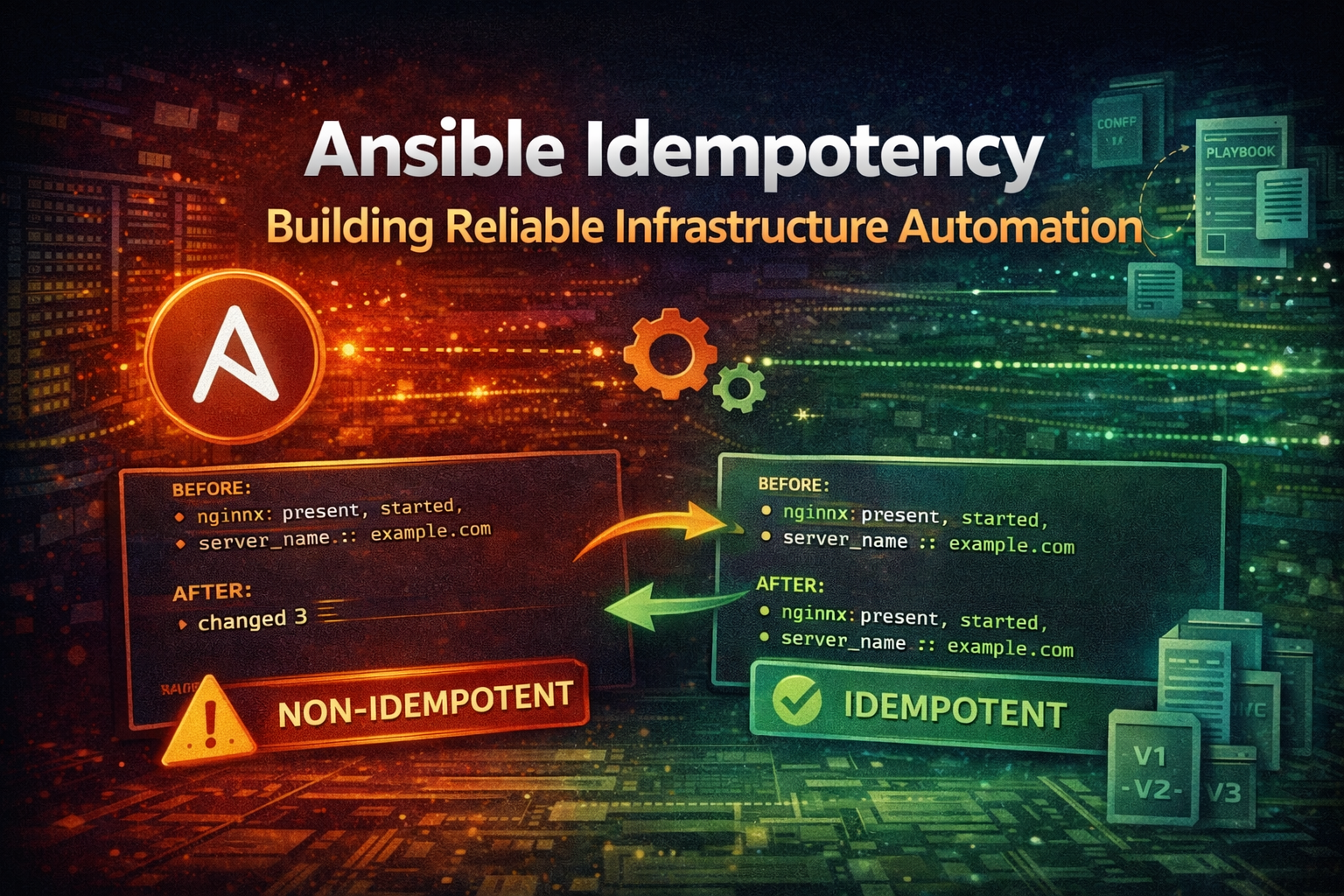
Master Ansible idempotency to write playbooks that safely run multiple times without side effects. Learn how to build production-grade automation that prevents configuration drift and infrastructure chaos.
Learn how ArgoCD implements GitOps principles to automate Kubernetes deployments. This guide covers core concepts, installation, and real-world patterns for managing applications declaratively.